Startup Booted Financial Modeling is key to growing a company without venture capital. It requires a mindset focused on increasing customer revenue. It emphasizes smart financial planning and controlled spending. Financial modeling helps founders achieve sustainable growth and goes beyond traditional investor spreadsheets. It serves as a strategic plan, helping founders determine whether their business can survive, expand, and scale. It also answers key financial questions.
For example, it answers questions like:
- How long can the company sustain operations?
- When will the startup reach break-even?
- What’s the most the company can safely split between hiring and marketing?
- What growth decisions ensure long-term financial sustainability?
Founders can build a clear financial model. This helps them see their cash flow, expenses, and long-term growth potential. Plus, they don’t have to give up equity to early investors. This guide explains startup financial modeling. It covers the frameworks founders should use and the metrics for financial sustainability.
What Is Startup Booted Financial Modeling?
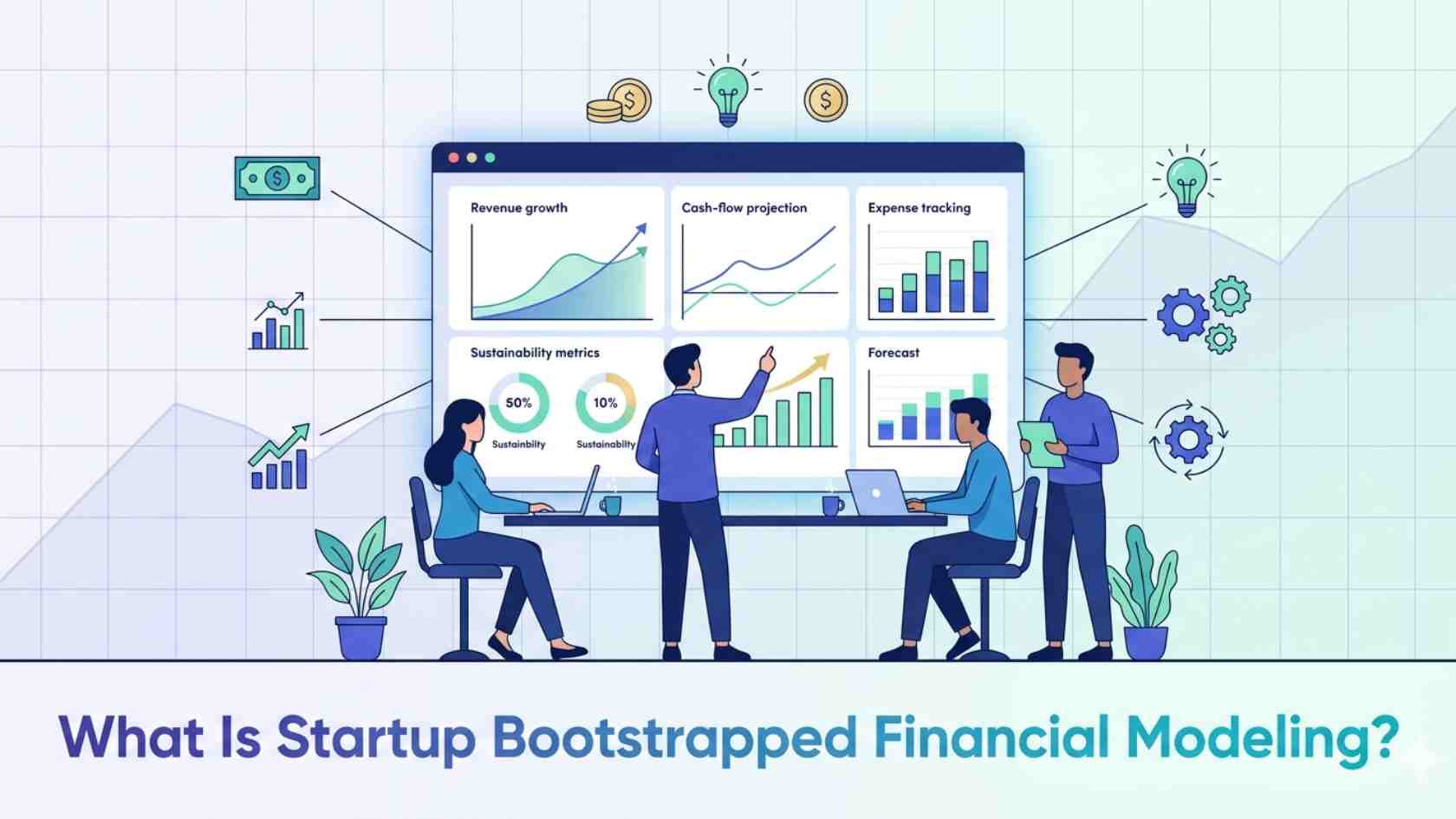
Startup Booted Financial Modeling forecasts and manages a startup’s finances. It focuses on internal revenue instead of relying on external funding. Bootstrapped financial models rely on the idea that customer revenue must cover operations. They do not want to depend on future funding rounds.
This revenue-first approach highlights five key principles:
1. Generate revenue quickly: Launch MVPs with pre-sales or beta pricing in 60 days. The first $1K shows real demand before you perfect it. Revenue validates faster than user praise.
2. Maintaining Lean Operating Costs:
- Keep fixed costs below 40% of revenue.
- Use free tools.
- Use independent freelancers and remote teams in place of hiring full-time employees. Aim to keep monthly operating costs under $5,000 in the early stage.
3. Keep a careful eye on cash flow: Verify weekly, not monthly, inflows and outflows. In this manner, you may immediately identify drops in your three-month runway. Net-7 invoices prevent payment delays, which can disrupt an otherwise profitable startup.
4. Break-even goal: In six to twelve months, aim for revenue.
To achieve self-sufficiency, the company requires $50K in sales to cover $30K in costs at a 60% margin.
Reinvest earnings strategically:
- 20% for personal use
- 30% for a cash buffer
- 50% for growth (retention tools)
5. Monitor quarterly ROI: double winners, cut losers. Founders prioritize actual business performance over anticipated finance. Based on real data, they develop financial models. The end product is a business that grows naturally and stays sustainable. Consider it akin to organizing a road trip. You spend petrol money and your car’s maintenance. Based on your budget, you schedule detours, snack stops, and fuel. This is a practical, realistic, and sustainable example of bootstrapped financial modeling.
Why Bootstrapped Financial Modeling Is Growing in 2026

More entrepreneurs are leaving the VC chase in 2026. There is a genuine slowdown in VC. According to Crunchbase, global funding decreased by more than 40% last year. Thus, cash-positive operations and profitability are more important than ever. Investors have become pickier due to economic concerns. Profitability is important these days. Attention is now on cash-positive businesses. This shift is happening because of higher borrowing rates and tech layoffs.
What about founder control? People are less interested in “growth at all costs.” It’s revolutionary. No need to chase hockey-stick growth for LPs. Also, the company does not sell board seats to outsiders.
Bootstrapped vs VC-Backed Startups
Bootstrapped startups lean on customer cash from day one, growing steadily without dilution. VC-backed companies spend investor funds fast to grow quickly. They often give away 20-50% equity in each round. Here’s a quick look at key differences:
Pros of Bootstrapping:
- You retain complete ownership until you choose to change that.
- Aligned incentives: Profit drives your decisions.
- Nimble pivots: You can change direction without needing investor approval.
Cons: Slower scaling, personal financial risk, and limited war chest for big bets.
VC pros: Massive capital for moonshots, networks, and talent wars.
Cons: Equity loss, milestone pressure, and “grow or die” vibes that lead to 90% failure rates.
Mailchimp is a famous bootstrapped startup. It reached a $12B exit without using venture capital. This shows that founders can become unicorns on their own.
Why Financial Modeling Is Critical for Bootstrapped Startups
The significance of financial modeling is often overlooked by early-stage entrepreneurs. They give marketing and product development top priority. Financial planning is often an afterthought. For bootstrapped startups, this can be dangerous. Founders without a clear financial model might overspend before revenue stabilizes. They might hire too soon, misjudge cash flow gaps, or run out of funds earlier than expected.
A well-built financial model provides several key benefits.
- Financial Visibility: A financial model illustrates the flow of funds within an organization. Founders can track monthly revenue growth, operating expenses, burn rate, and potential runway. This transparency prevents financial surprises.
- Spot a $5K shortfall two months away? Cut unnecessary advertisements and change course rather than rush.
- Improved Decision Making: Financial modeling transforms corporate choices into quantifiable financial results.
- Founders don’t have to guess if a decision is safe. They can check the costs of hiring new employees. They can also examine the ROI of marketing campaigns. Lastly, they should consider the financial impact of expanding operations. If you spend $2K on a Facebook ad and get 50 customers for $100 each month, you can tell it’s a winner before you commit.
- Instead of relying on venture financing, bootstrapped firms rely on their own revenue. Founders can keep greater ownership and decision-making authority as a result.
Financial modeling ensures that the company grows without requiring outside funding too soon.
Also Read: What Must an Entrepreneur Do After Creating a Business Plan?
Core Components of a Booted Startup Financial Model
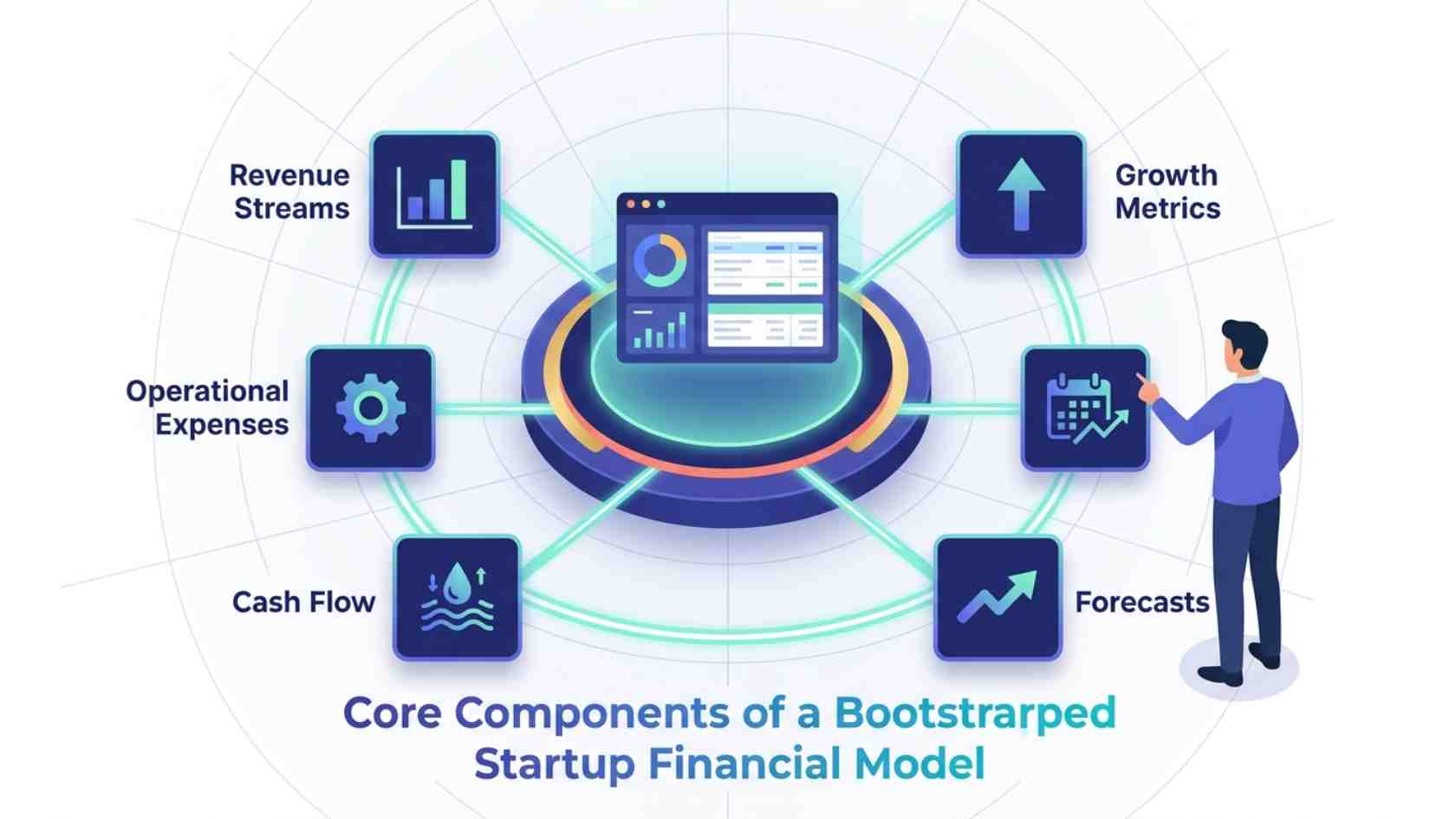
A strong startup financial model has key parts. These help founders understand how healthy their business is.
Revenue Projections: Revenue projections estimate the income a startup will make over time.
Founders should analyze these factors to create realistic projections:
- Average selling price
- Monthly customer acquisition
- Conversion rates
- Customer retention
Comprehending Unit Economics: Unit economics quantifies the profitability of customer acquisition and retention. Bootstrapped startups should keep fixed costs low in their early growth. This helps them manage resources better. Target fixed costs under 40% of revenue; go remote-first to slash rent.
Cash Flow Forecasting: Revenue does not always arrive at the same time as expenses must be paid. That is why cash flow forecasting is critical. A cash flow model shows cash coming into and going out of the business. It also tracks the monthly net cash movement.
This allows founders to identify cash shortages before they occur. Many startups fail not because they lack revenue, but because they run out of cash at the wrong time.
Best practice: Invoice weekly and actively follow up on payments
Break-Even Analysis: Understanding Profitability
The company needs to make $50,000 to break even. Fixed costs are $30,000 each month, and the gross margin is 60%. For bootstrapped startups, breaking even is crucial. Most bootstrapped businesses aim for financial independence in 12 to 18 months.
Understanding Unit Economics
Zoom in on per-customer math for profitability.
Two key metrics are:
Customer Acquisition Cost (CAC): This calculates the price of acquiring a new client. For instance, the CAC is $50 per customer if a business spends $5,000 on marketing and acquires 100 new clients.
Customer Lifetime Value (LTV): LTV measures the total revenue a client generates while they are with the business. The LTV is $600 if clients pay $50 a month and stay for a full year. An LTV-to-CAC ratio of at least 3:1 is typically maintained by healthy startups. This guarantees the continued profitability of customer acquisition.
Building a Simple Startup Booted Financial Modeling (Step-by-Step)
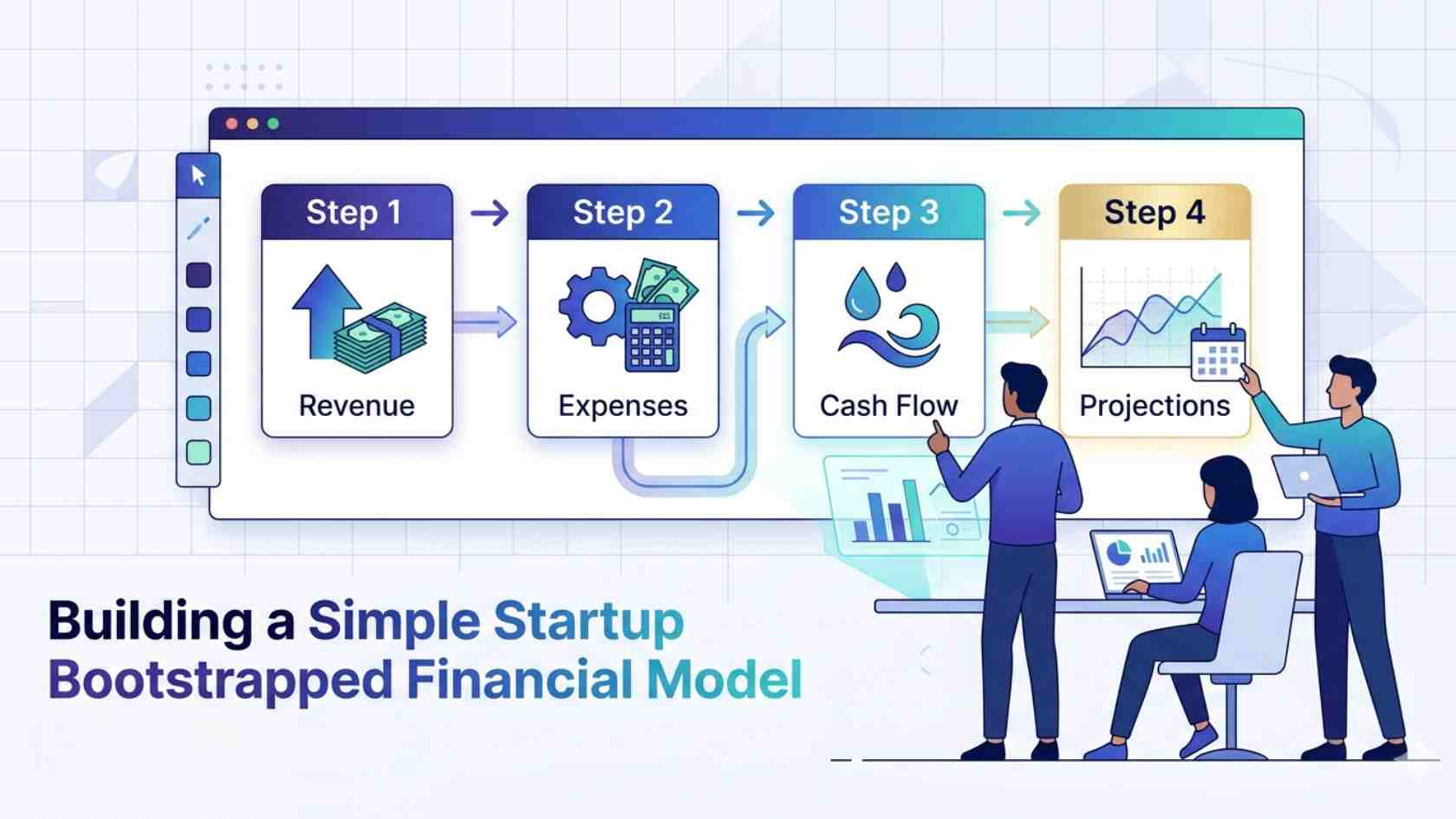
Founders do not need complex financial software to build a startup financial model. Many successful companies start with simple spreadsheets. Here is a basic framework.
Step 1: Define Your Revenue Model
Start by identifying all possible revenue streams. Examples include subscriptions, one-time product sales, service packages, and consulting add-ons. Clearly defining income sources helps build accurate projections. List them in column A of your sheet.
Step 2: Forecast Monthly Revenue
Calculate the number of new clients you can attract each month. Next, multiply that figure by the cost of your product.
Steer clear of unrealistic growth predictions. Rather, build forecasts on actual conversion and marketing effectiveness data. For small growth, use =previous_month * 1.15.
Step 3: List All Operating Expenses
Add all the costs associated with operating the business. This includes hosting infrastructure, software tools, marketing budgets, and salaries.
Separating fixed and variable costs makes forecasting more comfortable. Total them in a running sum.
Step 4: Calculate Cash Runway
The startup’s cash runway shows how long it can operate before running out of money.
For instance, the runway is twelve months if your firm has a budget of $120,000 and spends $10,000 every month. Experts say bootstrapped firms need at least three to six months of runway. = cash_balance / monthly_burn is the formula.
Step 5: Create Growth Scenarios. Smart founders make different financial plans:
- Conservative Scenario: Revenue grows more slowly than expected.
- Realistic Scenario: Growth follows current trends.
- Optimistic Scenario: Marketing performs better than expected.
Scenario planning prepares the startup for uncertainty. Duplicate tabs for each.
Financial Modeling Stages for Bootstrapped Startups
Startup financial models often evolve as the company grows.
Pre-Revenue Stage Focus on:
- Product development costs
- MVP launch expenses
- Minimal operational spending
The goal is to validate demand while conserving capital. Cap spending between $10,000 and $20,000.
Early Revenue Stage: Once revenue starts, founders should track:
- Customer acquisition costs
- Churn rates
- Monthly recurring revenue
At this stage, we determine whether the startup has achieved product-market fit. Aim for a maximum churn of 5%.
Expansion Stage financial models focus on achieving effective scaling during expansion. Strategic hiring, increasing marketing expenditures, and enhancing retention are top priorities. The reinvestment of profits drives growth. Double revenue before doubling headcount.
Scaling Stage: At this stage, founders might think about:
- Expanding into new markets
- Building larger teams
- Raising strategic funding if needed
Since the company has revenue traction, founders can negotiate from a position of strength.
Common Financial Modeling Mistakes Founders Make

Even experienced founders make mistakes when building financial models.
- Overestimating Revenue. Real client acquisition challenges are sometimes overlooked by optimistic estimates. Don’t exceed 70% of your best estimate.
- Hidden costs: software tools and marketing testing can accumulate rapidly.
- So can infrastructure upgrades. Add 20% buffer.
- Even profitable businesses can encounter cash shortages if they ignore cash flow timing.
- Failing to update the model, financial models must evolve with real business performance.
Updating projections monthly ensures decisions remain grounded in reality. Set a calendar reminder.
Tools for Startup Financial Modeling
Before embracing more sophisticated platforms, the majority of founders begin with basic tools.
Common tools are:
- Google Sheets or Excel for financial projections: You can find free or cheap templates with formulas for:
- Revenue forecasts
- Cash flow
- Scenarios
Drag-drop charts show the runway and break-even points. This makes coding unnecessary. Shareable links let co-founders collaborate live.
- QuickBooks helps with accounting and tracking: It sorts bank feeds, invoices, and taxes without manual input. This makes it easy to find overspending without delay. Real-time P&L reports integrate with banks for an accurate burn rate. Bootstrappers love the $30/month Online plan for startups.
- Baremetrics and ChartMogul track MRR, churn, and LTV/CAC ratios. They pull data straight from Stripe. They provide alerts for revenue drops and benchmarks against industry averages. Baremetrics starts at $50 per month. ChartMogul also provides similar features but includes advanced cohort analysis.
- Notion or Airtable for scenario planning: Create interactive “what-if” pages. Connect revenue sliders to expense outcomes. Notion’s free for solos; Airtable ($20/user) handles databases of scenarios. Visual boards provide a straightforward comparison of conservative and optimistic paths.
The key is not the complexity of the tool but the accuracy of the data used. Free templates abound on Gumroad or Reddit’s r/startups.
Also Read: Startup Booted Fundraising Strategy: How to Grow Without Relying on Venture Capital
Conclusion: Why Financial Modeling Matters for Bootstrapped Startups
Startup Booted Financial Modeling is more than a budgeting exercise. It is the financial operating system of a bootstrapped company. Founders can build successful businesses without early venture funding. Founders should focus on these key areas:
- Growing revenue
- Managing expenses with precision
Successful bootstrapped startups have key financial habits. They use cautious revenue forecasts. They maintain strong unit economics, control costs effectively, and monitor finances regularly. When these principles guide decisions, a startup moves from a risky test to a stable, revenue-focused business. When a business shows its financial strength, founders gain something even better than early funding. They get the freedom to decide when, or if, they want to raise capital.
FAQS
What is Bootstrapped Startup Financial Modeling?
Bootstrapped startup financial modeling is a way for startups to plan their finances. They use their own revenue, not outside funding. It helps founders forecast income, control expenses, and achieve sustainable growth.
Why is Startup Booted Financial Modeling important for bootstrapped startups?
For bootstrapped startups, every dollar counts. Startup Booted Financial Modeling provides a clear guide for spending, earning, and growing. This helps founders expand efficiently without needing outside investors.
How does Startup Booted Financial Modeling differ from traditional financial modeling?
Startup Booted Financial Modeling is different from traditional models aimed at investors. It emphasizes practical, revenue-driven choices. It helps founders prioritize customer revenue, disciplined spending, and sustainable growth.
What key elements are included in Startup Booted Financial Modeling?
It includes revenue forecasts, tracks costs, and analyzes cash flow. It also finds break-even points and makes growth plans. These elements guide founders in making informed decisions while maintaining financial control.
Can Startup Booted Financial Modeling help secure investors in the future?
Yes. Startup Booted Financial Modeling is made for bootstrapped growth. It builds a strong financial base. This can draw in investors later by showing a clear route to profit and steady growth.