A call from your bank’s fraud department informs you that there is suspicious activity. The voice sounds precisely like customer service reps you’ve spoken to in the past — professional, distinct, and with just a little bit of background noise suggesting a call center. You click the confirmation and confirm that you are ok with the transaction. Then, a few days later, you find out the call was made entirely through voice synthesis and you’ve unwittingly approved a fake transfer. This is no idle hypothetical fear-mongering — it’s already happening more and more often as synthetic voice generation gets good enough to consistently fool listeners.
The tech underlying these convincing audio forgeries has been a force of good in legitimate and beneficial ways throughout entertainment, accessibility and beyond. Voice artists can preserve their performances with synthesis. Podcasters can clean up errors without having to re-record entire sections. Developers can now create dynamic dialog for a game without having to record every possible version of it.
But the same features that allow for this creativity also allow for deception, impersonation and fraud at levels hitherto unavailable. Regulatory and validation systems that are designed to prevent misuse are lagging behind the speed at which technology is developing and becoming available.
The Current State of Audio Authentication
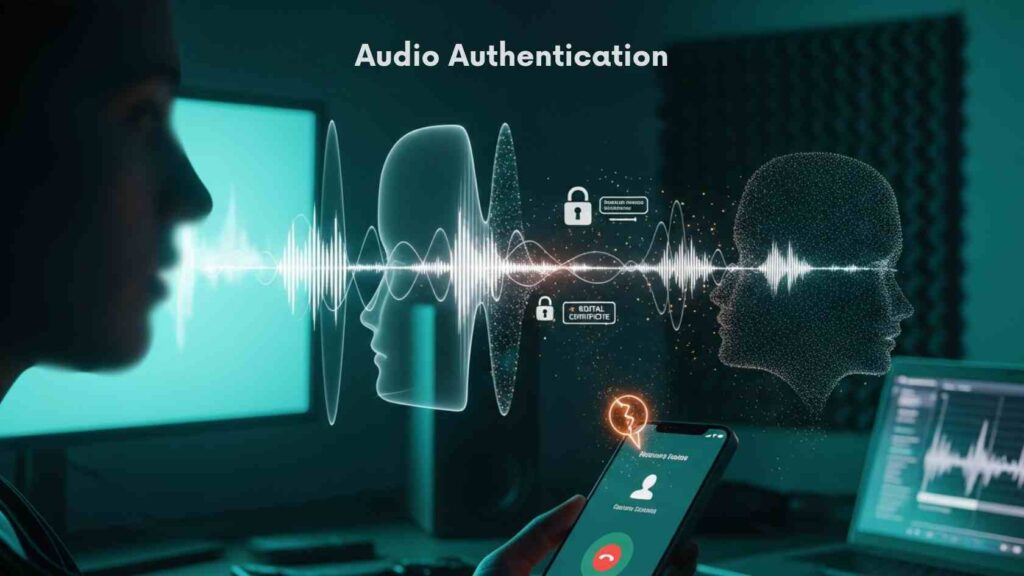
Authenticity determination of audio, i.e., whether it is real or fake (i.e. synthesized) carries out today based on both technical and contextual analysis. Forensic audio experts listen to recordings for telltale signs that homegrown technology can’t replicate (subtle changes in rhythms or breathe patterns, weird transitions between phonemes, background noise that doesn’t align with the recording environment as described or frequency characteristics inconsistent with a human voice).
These methods do a middling job of identifying contemporary synthesis, but every advance in the technology underlying this work makes it more difficult to detect. What the forensic tools of today reliably flag can be made undetectable within months, as a new generation of synthesis models tackles those telltale signatures.
Another form of authentication is based on watermarking: synthetic audio is tagged with a watermark that can serves as an indication for its artificial nature. Several tech giants have put forward standards for embedding these digital signatures into generated content, and with such a mark in place, detection tools should be able to identify even 100 percent realistic-sounding synthetic audio.
Thirdly, proof with transaction histories based on blockchain is provided for verification systems to create non-modifiable audio sources. A cryptographic hash of the recording and metadata regarding all of the recording sessions that get created is stored on a distributed ledger when content gets generated. Later authentication can be accomplished in real time by examining the hash of any challenged portion of audio against the blockchain.
Regulatory Frameworks Taking Shape
There is legislation on synthetic audio coming through both the states and federally, but it’s inconsistent. A couple of US states have passed laws that go after deepfake audio in political campaigns, compelling disclosure if a candidate uses one to spread the message through election-related communications. California’s law goes beyond politics, making it illegal to use someone’s bot-voiced doppelgänger in commercial circumstances without their consent.
These laws set useful precedents, but enforcement is a problem—identifying violations is not something most regulators have the technical chops (or funding) for, and it’s not clear that responsibility lays when content creation, hosting, and viewing happens in separate jurisdictions.
(Much like the entire prospect of Kindle-like “burn after reading” type reforms in CIA and other IC guidelines with such a reform, that would only work if dissemination were sharply curtailed.) These industry specific “limits” offer more refined protection than broad regulation because they respond to how technology is actually used in professional settings. Input resources that facilitate authentic audio production, such as professional Sound Effects libraries, may assist with maintaining authenticity in synthesized audio by having at least partially real recorded audio.
Challenges in international alignment on regulations There are plenty. What counts as unacceptable voice synthesis depends on a particular jurisdiction’s cultural attitudes toward privacy, identity and freedom of expression. The European Union’s response, based on new elements in the Digital Services Act, is transparency and user rights.
China has introduced strict registration requirements for deepfake technology and content labeling. It is difficult for platforms that work globally to navigate these fragmented regulatory architectures, and enforcement is inconsistent depending on the place origin of content and harm.
Technical Countermeasures and Detection Tools
At the same time as synthetic approaches to new drugs improve, so does the technology of detection evolve and is also embroiled in a ” continuing war of innovation. They’ve found that audio can be similarly “fingerprinted” and are researching analysis tools based on an examination of sound at microscopic levels, with the aim of identifying the mathematical patterns that modern synthesis models always introduce. These tools have achieved remarkable accuracy in controlled settings, correctly identifying synthetic audio 95% or more of the time. In practice performance isn’t always dependable, as the quality of audio changes and recordings are processed, compressed and synthesizing techniques change to defeat known detection methods.
The best detection strategies are multi technique anal ysis rather than a single probe. An integrated authentication system could look at spectral features, temporal signatures of speech, environmental noise correlation, and actual voice properties in relation to samples of claimed speakers. By forcing multiple verification sums to cohere, these layered systems are more difficult to game even when individual detection methods might be compromised. The computational demands of comprehensive verification continue to be significant, and deployment is mostly limited to high-value tasks and not routine audio authentication.
Also Read: The Technology Behind Rainbow Six Siege Boosting
Practical Implications for Content Creators and Consumers
Content creators who or with synthetic audio now experience a mounting pressure to explicitly mark when voices have been made instead of recorded. This transparency can be multi-Purposeful — it resists allegations of trickery, respects the rights of people whose voices might have been synthesized and helps audiences build a healthy doubt of anything they hear. The question is: how obvious should those disclosures be in order to be effective, and without stripping the content of value or entertainment? A quiet disclaimer that viewers fail to notice is negating the point, though obtrusive labeling can detract from storytelling or user experience.
The way ahead will need to see co-ordination of technology development, regulation, industry standards and public understanding. Technical solutions alone are not going to solve the problem without legal frameworks that make enforcement possible. Regulations are useless if there aren’t detection capabilities that actually find violations. And neither technology nor legislation can shield those who are unaware of the ways in which synthetic audio can be used — and abused. The solution is not to ban screens or any other beneficial uses of voice synthesis, but rather to develop systems that maintain trust in audio communication while giving good actors room.