A scalable web hosting plan allows a website to handle increases or decreases in traffic without causing serious performance problems, unexpected outages, or a poor user experience. Instead of moving to an entirely new server whenever the business grows, website owners can increase resources such as processing power, memory, and storage as their requirements change.
For example, a growing website might begin with 2 vCPUs, 4 GB of RAM, and 50 GB of SSD storage. As traffic and resource usage increase, the business may upgrade to a more powerful configuration. However, server capacity should not be measured by monthly visitor numbers alone. The amount of traffic a server can support depends on several factors, including the website’s software, caching system, database activity, plugins, simultaneous users, and use of a content delivery network.
This flexibility is particularly valuable for growing companies and businesses with seasonal traffic patterns. Ecommerce sales, product launches, advertising campaigns, and holiday promotions can all cause sudden increases in website activity. Scalable hosting helps a website respond to these changes without forcing the business to pay for maximum capacity throughout the year.
The Effects of Poor Scalability on a Business Website

A website that cannot scale effectively may become slow, unstable, or temporarily unavailable when traffic increases. These problems can damage the user experience and make it more difficult for visitors to browse products, submit enquiries, complete purchases, or access important information.
Performance issues are especially damaging for ecommerce and service-based websites. A customer who encounters a slow product page or an unresponsive checkout process may leave the website and purchase from a competitor instead. Even when a website does not crash completely, delayed page loading, database errors, and failed transactions can lead to lost revenue.
Poor scalability may also affect a company’s reputation. Customers expect business websites to remain available and responsive, particularly during sales, events, and product launches. Repeated outages can reduce confidence in the brand and create additional work for customer support teams.
Search visibility may also be affected when performance problems become persistent. Website speed and page experience are not the only factors used by search engines, but they contribute to the overall usability of a website. A stable and properly optimized hosting environment provides a stronger technical foundation for SEO, content publishing, and long-term growth.
Scalable Hosting Options for Growing Businesses
Different hosting environments offer different levels of scalability. The right choice depends on the size of the website, its expected workload, the technical expertise available, and the importance of uninterrupted availability.
VPS Hosting
A virtual private server, commonly known as a VPS, provides dedicated portions of CPU, memory, and storage within a physical server. It usually offers more control, stability, and resource availability than standard shared hosting.
VPS hosting can be a practical choice for small and medium-sized businesses that have outgrown shared hosting but do not yet require a complex cloud infrastructure. Depending on the provider, resources may be increased by upgrading the existing plan or moving the website to a more powerful server configuration.
Businesses comparing managed solutions such as fast VPS hosting should look beyond headline specifications. Important factors include the quality of the server hardware, technical support, backup policies, security management, data-centre locations, and the provider’s upgrade process.
It is also important to understand that adding more CPU or RAM does not automatically solve every performance problem. A website may remain slow because of inefficient database queries, oversized images, poorly coded plugins, external scripts, or insufficient caching. Server upgrades should therefore be supported by performance testing and website optimization.
Some VPS upgrades can be completed quickly, while others may require a server restart or a short period of downtime. Businesses should confirm the migration and upgrade procedures with the hosting provider before choosing a plan.
Cloud Hosting
Cloud hosting uses a network of connected computing resources instead of depending entirely on one physical server. This structure can make it easier to add or remove capacity as website demand changes.
Cloud environments can support two main types of scaling. Vertical scaling increases the resources available to an existing server, such as adding more memory or processing power. Horizontal scaling adds more server instances and distributes traffic between them.
Horizontal scaling can be particularly useful for websites and applications that experience large or unpredictable traffic spikes. However, it normally requires a suitable application architecture, load balancing, automated health checks, and properly configured databases.
Cloud hosting should not automatically be treated as completely outage-proof. High availability depends on how the infrastructure is configured. If the website still depends on one application server, one database, or another single point of failure, an outage may still occur.
For a mission-critical website, the hosting environment may include multiple application servers, replicated data, automated backups, monitoring systems, and failover arrangements. When one server becomes unavailable, traffic can then be redirected to healthy infrastructure.
Managed Hosting
Managed hosting can be useful for businesses that do not have an internal server-administration team. Under a managed plan, the provider may handle tasks such as operating-system updates, security patches, monitoring, backups, and technical troubleshooting.
The exact level of management varies significantly between providers. Business owners should carefully review what is included rather than assuming that every managed service offers the same level of support.
A reliable managed hosting provider should clearly explain:
- How server resources can be upgraded or downgraded
- Whether upgrades require downtime
- How often backups are created and how long they are retained
- How quickly support responds to critical issues
- Whether malware scanning and security monitoring are included
- What uptime commitment is covered by the service-level agreement
How to Choose a Scalable Hosting Plan

Choosing scalable hosting requires more than comparing RAM, CPU, and storage. Businesses should evaluate how the hosting platform will perform under real operating conditions.
Start by reviewing current website usage. Check memory consumption, CPU load, database activity, bandwidth, and the number of simultaneous visitors during busy periods. This information can help determine whether the current limitations are caused by insufficient server resources or website-level inefficiencies.
The hosting provider should also offer a clear upgrade path. Ask whether resources can be added without a full migration and whether the provider supports temporary capacity increases during seasonal campaigns.
Businesses should also examine backup and recovery procedures. A backup is useful only when it can be restored successfully and within an acceptable period. Important websites may require off-site backups, multiple restore points, and regular recovery testing.
Server location is another important consideration. Hosting the website closer to its main audience can reduce network delay. A content delivery network can further improve performance by serving images, scripts, and other static files from locations closer to visitors.
Security should be evaluated at the same time as scalability. As a website grows, it may attract more malicious traffic, login attempts, and automated bots. Firewalls, malware protection, access controls, and software updates should therefore form part of the hosting strategy.
Emerging Trends in Web Hosting
Web hosting continues to develop as businesses demand better performance, greater flexibility, and more efficient use of computing resources.
Green Hosting
Green hosting is receiving more attention as companies look for ways to reduce the environmental impact of their digital operations. Some hosting providers use renewable energy, carbon-offset programmes, or energy-efficient data centres.
Businesses making environmental claims should review the provider’s published policies and independent certifications rather than relying only on marketing language.
Artificial Intelligence and Automated Monitoring
Artificial intelligence and machine learning are being used in areas such as traffic monitoring, threat detection, server optimization, and predictive maintenance. These tools may help hosting providers identify unusual activity or resource shortages before they cause serious disruption.
However, automated systems still require appropriate configuration, regular evaluation, and human oversight.
Edge Computing
Edge computing can improve response times by processing selected data closer to the user rather than sending every request to one central server. It can be valuable for global websites, real-time applications, and services that are sensitive to network delay.
Serverless Hosting
Serverless platforms offer another approach to scalability. They allow developers to run specific functions without directly managing the underlying servers. Resources can be allocated automatically when requests occur, which may be useful for APIs, scheduled tasks, and event-driven applications.
Serverless hosting is not suitable for every workload. Businesses should consider technical limitations, pricing models, application requirements, and the risk of becoming dependent on one platform.
Scalable Hosting Supports Long-Term Website Growth
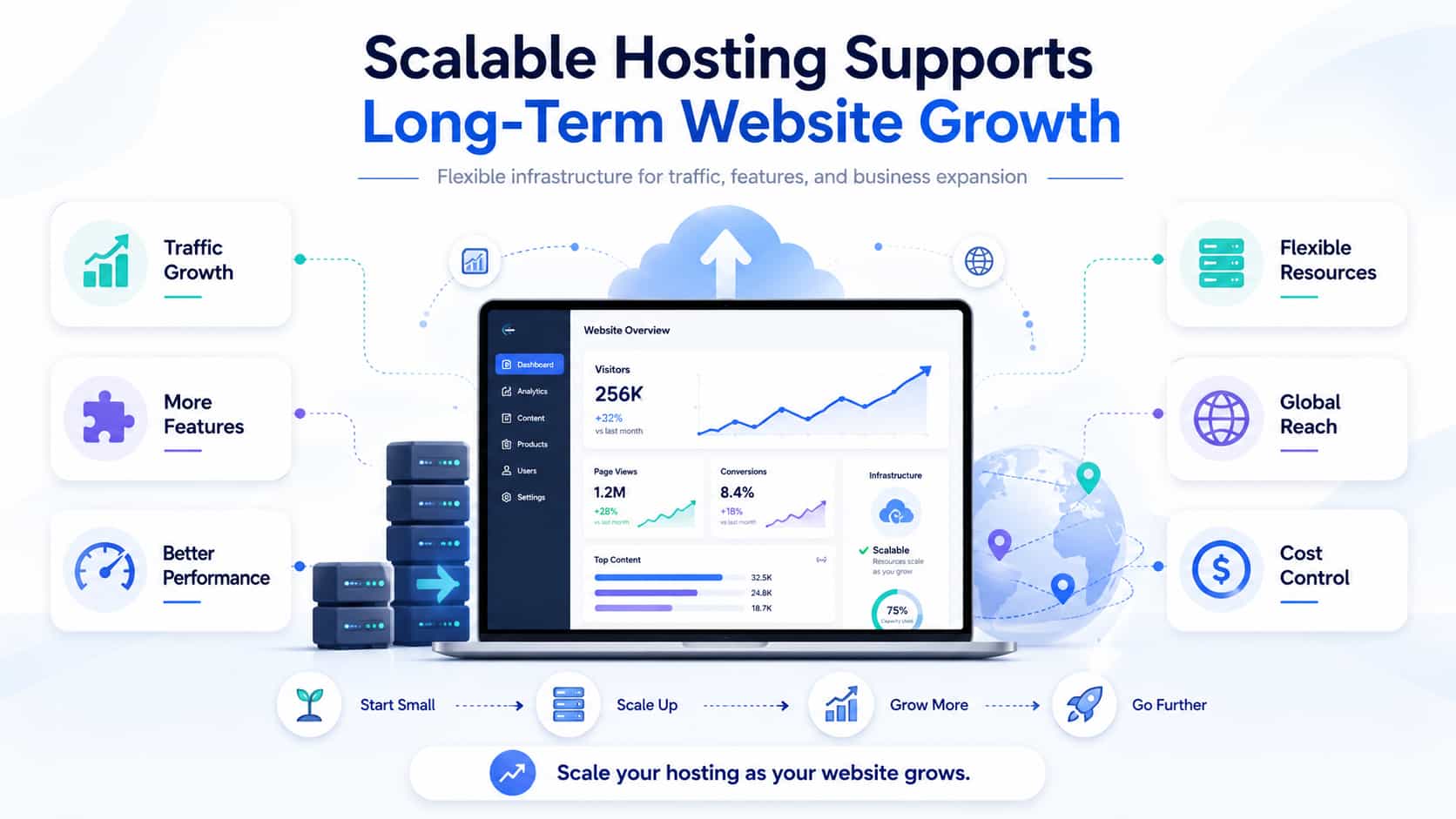
A business website rarely remains unchanged. It may grow through new service pages, a larger product catalogue, customer accounts, online booking systems, international expansion, or consistent quality content marketing.
Each new feature can increase the demand placed on the server. A scalable hosting environment allows the website to support that growth without requiring a complete rebuild every time its resource requirements change.
Scalability also gives businesses more control over costs. A company can begin with a plan that matches its current needs and increase resources as traffic, sales, and functionality expand. This approach is often more economical than paying from the beginning for infrastructure designed around the busiest possible day.
However, the cheapest hosting plan is not always the most cost-effective choice. Frequent downtime, slow support, and difficult migrations can cost more than the initial savings. Businesses should consider reliability, technical assistance, backup quality, and upgrade flexibility alongside the monthly price.
Also Read: Top 10 Most Successful Businesses to Start in 2026
Final Thoughts
Scalable hosting provides the technical flexibility a business needs to handle growth, seasonal demand, and changing website requirements. VPS hosting may be suitable for businesses that need dedicated resources and greater control, while cloud hosting can offer more advanced scaling and redundancy when configured correctly.
No hosting platform can guarantee strong performance without proper website optimization, security, monitoring, and backup procedures. The best results come from combining suitable infrastructure with efficient code, reliable caching, regular maintenance, and a clear recovery plan.
Before choosing a provider, businesses should review technical documentation, service-level agreements, backup procedures, support availability, and upgrade policies. A well-planned hosting environment does more than keep a website online. It supports customer confidence, operational stability, and sustainable long-term growth.