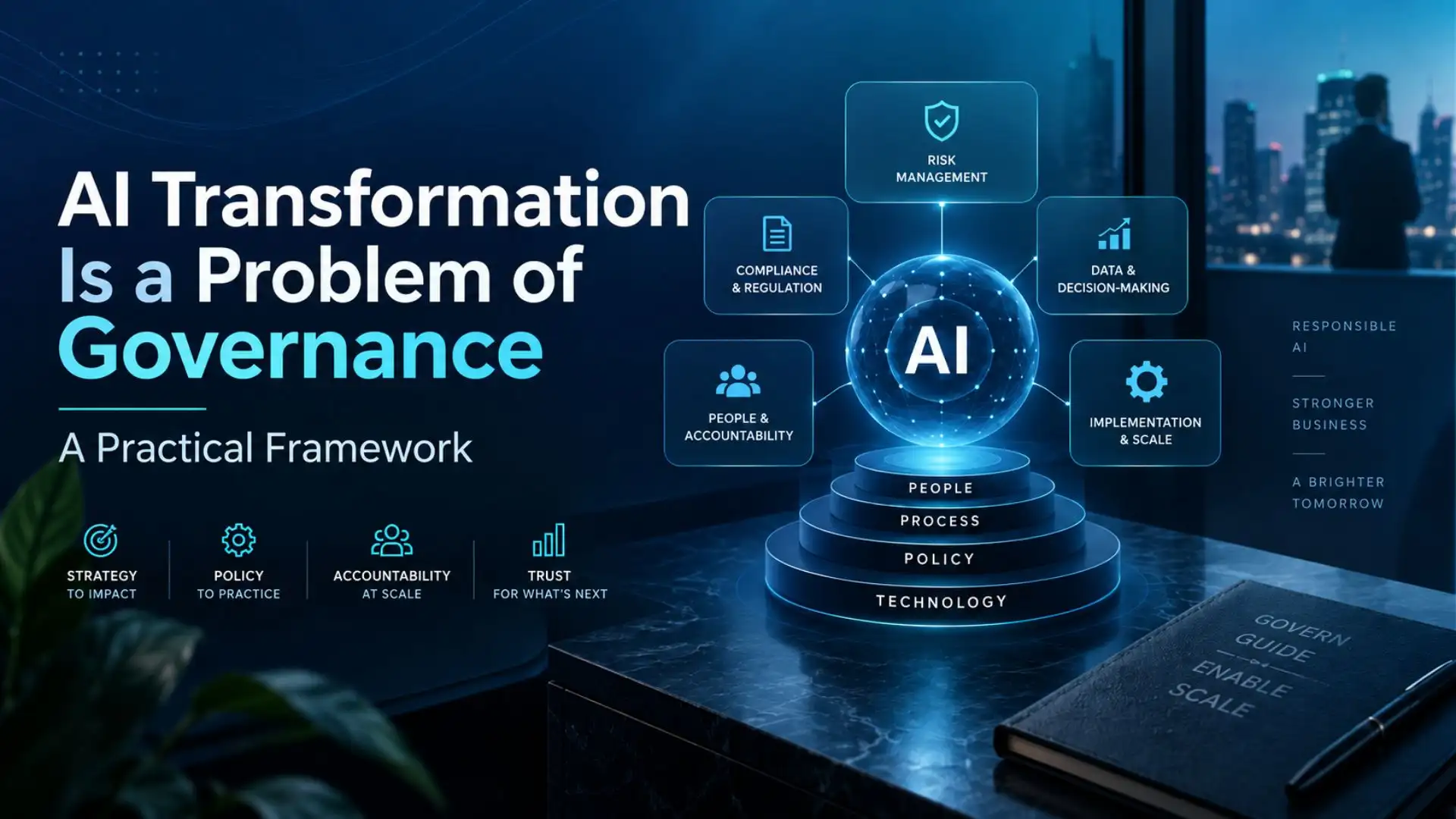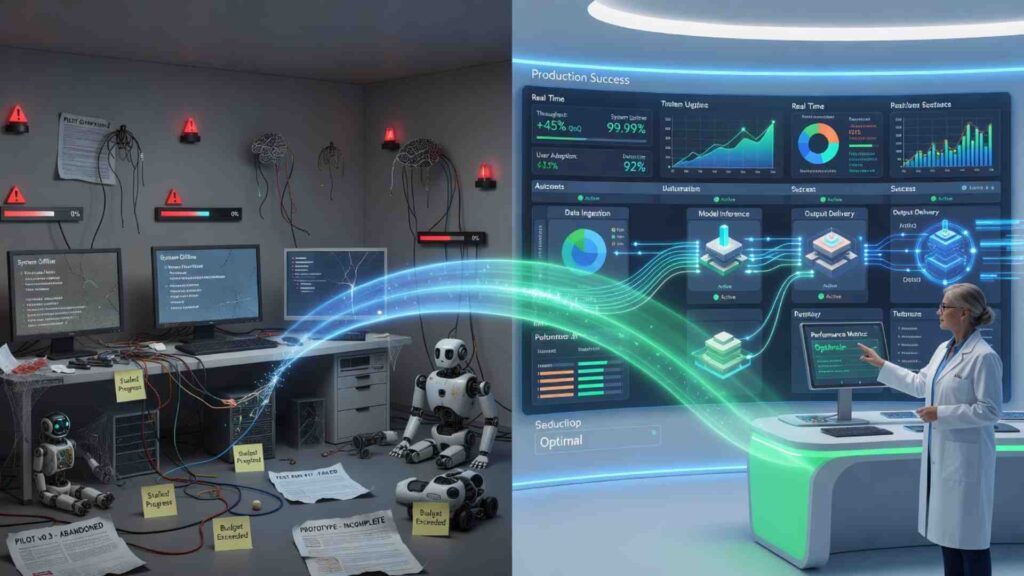
In 2025, global enterprises invested $684 billion in AI initiatives. By year-end, analysis from multiple sources estimated that over $547 billion of that investment — more than 80% — failed to deliver intended business value. Large enterprises lost an average of $7.2 million per failed initiative and abandoned an average of 2.3 initiatives each. These are not experimental budgets. These are serious strategic bets that produced nothing.
The question every enterprise leader should be asking is not whether to invest in AI, but why the success rate is so catastrophically low when the underlying technology has never been better. The answer, consistently across every major research study, points to the same root cause: the problem is not the AI. It is how organisations buy, build, and manage it.
The Three Failure Modes That Kill Enterprise AI Projects
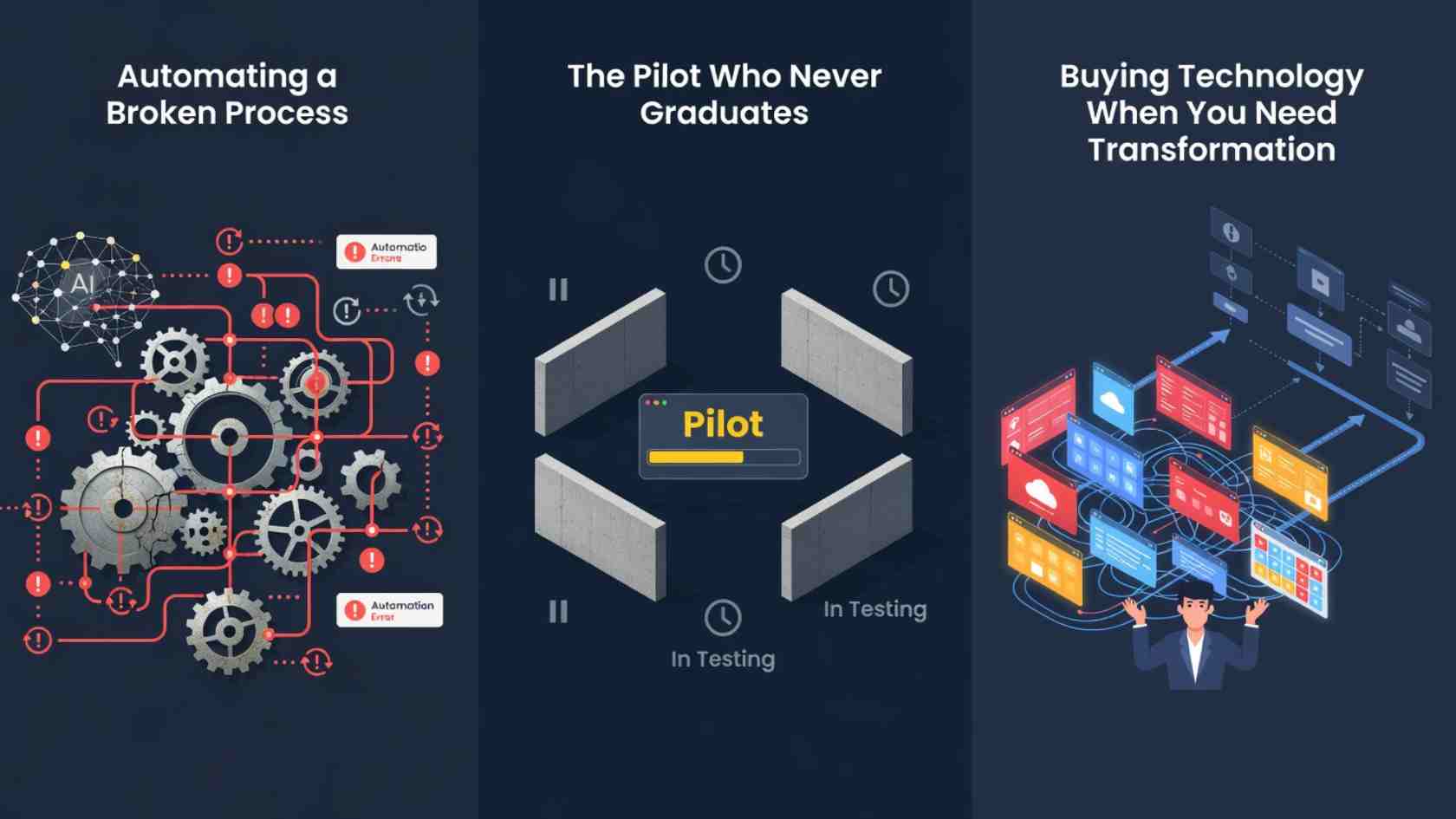
Failure Mode 1: Automating a Broken Process
Gartner predicts 40% of agentic AI projects will fail by 2027 for this exact reason. Organisations take an existing workflow — procurement approval chains, customer service escalation paths, compliance review cycles — and layer AI on top without examining whether the underlying process makes sense. The AI faithfully replicates and accelerates a process that was already dysfunctional, producing bad outcomes faster.
Failure Mode 2: The Pilot Who Never Graduates
Deloitte’s State of AI in the Enterprise 2026 found that while 38% of organisations are piloting agentic AI, only 11% have reached production. The pilot trap is real and measurable. Organisations build impressive demos on clean data with cooperative users, declare success, and then discover that production requires integration with legacy systems, compliance sign-off from legal, data governance frameworks that do not exist yet, and change management for teams who were never consulted. S&P Global reported that 42% of companies scrapped most of their AI initiatives in 2025, up from 17% the year before.
Failure Mode 3: Buying Technology When you Need Transformation
MIT’s 2025 study of corporate AI failures found that 95% of generative AI pilots failed to create measurable value. Their analysis pointed consistently to organisational factors, not technical ones. The technology worked. What did not work was the gap between what the AI could do and what the organisation was ready to absorb. As analysis of how AI companies are reshaping UK enterprises makes clear, the firms delivering real impact are the ones treating AI as an operating model shift, not a technology bolt-on.
What the Data Tells Us About Successful AI Deployments
BCG’s September 2025 research found that AI leaders — companies that have successfully scaled AI — outpace laggards with double the revenue growth and 40% more cost savings. The gap between getting it right and getting it wrong is not marginal. It is existential.

So what do the successful deployments have in common?
They start with the operating model, not the model
The most successful AI implementations begin with a clear picture of how work actually flows through the organisation — not how it is documented in process maps, but how it actually happens. They identify where human judgment adds value and where it creates a bottleneck. They redesign the workflow first, then build the AI to fit the new design.
They treat production constraints as design requirements
Successful projects do not defer questions about data quality, legacy integration, compliance, and security until after the pilot. They build to production spec from day one. This is slower at the start and dramatically faster overall, because it eliminates the rebuild cycle that kills most projects between pilot and production.
They measure business outcomes, not model performance
A model with 94% accuracy that nobody uses has zero business value. AMD’s partnership with Kore.ai to deploy AI-powered HR agents achieved an 80% reduction in time to resolve HR inquiries and 70% employee satisfaction within 90 days. Mercedes-Benz Financial Services saw 20% growth in new business acquisitions after deploying agentic AI in its CRM. These are business metrics, not technical benchmarks.
The Agentic Shift Changes Everything
McKinsey’s 2026 State of AI Trust report found that 23% of organisations are now scaling agentic AI, with another 39% experimenting. BCG values the agentic AI services opportunity at $200 billion in net new demand. London has emerged as a major nerve centre for this shift, with a concentration of specialist firms building the infrastructure for enterprise agentic deployments. This is not a feature upgrade. It is a fundamentally different architecture that requires different expertise to build and govern.
An agentic system does not wait for a prompt. It reasons about a goal, plans a sequence of actions, executes them across multiple tools and data sources, evaluates the result, and adjusts. In financial services, banks implementing agentic AI for KYC and AML workflows are reporting productivity gains of 200% to 2,000%. Siemens and PepsiCo unveiled AI agents at CES 2026 that simulate supply chain changes with physics-level accuracy before any physical modification.
But McKinsey’s research highlights a critical governance challenge: in the agentic era, organisations must contend not just with AI saying the wrong thing, but with AI doing the wrong thing — taking unintended actions, misusing tools, or operating beyond appropriate guardrails. Only one-third of organisations report maturity levels of three or higher in agentic AI governance. As IntelligentHQ recently explored, the question of who watches the agent once it ships is becoming the defining governance challenge of this era.
Why Your Choice of Consultancy Partner Is the Highest-Leverage Decision You Will Make

Given these failure rates and the complexity of the agentic transition, the consultancy you select is not a procurement decision. It is a strategic one that will determine whether your AI investment joins the 80% that fail or the 20% that transform.
The firms that consistently deliver production outcomes share a recognisable profile. They lead with organisational diagnosis, not technology selection. They have opinions about how your operating model needs to change, and they are willing to tell you things you do not want to hear. They can show you production systems, not decks. They understand agentic architecture deeply enough to explain the governance implications, not just the capabilities.
Some firms have made this their entire focus. Consultancies specialising in agentic enterprise transformation are building the muscle memory for exactly the kind of deployment that most organisations are still struggling to get past the pilot stage. When 75% of enterprises tell BCG they want to work with a service provider on their priority AI use cases, the question is not whether to hire a consultancy. It is whether you are hiring one who has already solved the problems you are about to encounter.
Five Questions Before You Sign
Before committing to an AI consultancy engagement, demand clear answers to these:
- What percentage of your AI projects reached production in 2025, and what was the average time from kickoff to live deployment?
- Walk me through how you handled a compliance or governance challenge on an agentic AI deployment. What guardrails did you build, and how were they tested?
- Describe a project where your initial technical recommendation was wrong. What changed, and how did you handle it with the client?
- What is your approach to workforce change management alongside AI implementation? Who on your team owns that workstream?
- At what point in the engagement do you begin knowledge transfer to our internal team, and what does that process look like in practice?
The $684 billion invested in 2025 produced far less value than it should have. The technology was never the constraint. The next wave of enterprise AI, led by agentic systems that can reason and act autonomously, will be even more powerful and even less forgiving of poor partner selection. Choose accordingly.