
Gaming infrastructure is shifting away from self-managed physical servers toward managed, cloud-hosted game server environments built for low latency, scalability, and global availability. The transition echoes the way Software as a Service (SaaS) reduced the need for businesses to maintain their own software infrastructure, although managed game hosting serves a different technical purpose.
Players now expect responsive, highly available multiplayer sessions regardless of where they are located, pushing hosting providers to treat distributed data centers, flexible resource scaling, and layered DDoS protection as standard requirements, not premium extras. Providers such as Godlike Host, which offers dedicated multiplayer hosting for titles including Minecraft, Rust, ARK, and Palworld, are part of this broader shift.
Marketing claims aside, what matters most is measurable performance: latency, uptime, and how well the infrastructure holds up when player activity increases unexpectedly. Cloud networking, broader data-center coverage, automated monitoring, and more responsive traffic management are all advancing at the same time. The practical effect: dependable game infrastructure is becoming table stakes, not a differentiator.
What is GaaS and Why It Matters?
Managed game server hosting means that a dedicated or virtual server handles the multiplayer session, including game logic, player connections, and the persistent state of the game world. The player’s own device still runs and renders the game.
This is different from cloud gaming, sometimes called game streaming, where the game is rendered on a remote GPU server and streamed to the player’s screen as video. It is also different from the live-service business model commonly known as Games as a Service, which refers to ongoing seasons, updates, downloadable content, and post-launch monetization rather than the underlying server infrastructure.
This article focuses specifically on the servers and supporting systems that keep multiplayer sessions running.

For developers, managed hosting reduces much of the cost and complexity associated with maintaining physical infrastructure. Updates can be deployed centrally, server resources can be increased as player activity grows, and reaching players in different regions no longer requires a studio to build and operate its own network of server facilities.
For players, the practical benefits include more reliable connections, reduced waiting times, and steadier availability during periods of high demand.
Server infrastructure is only one part of a successful global launch. Studios must also invest in proper video game localization, including the adaptation of language, cultural references, interface elements, and other content for each target market. A technically successful worldwide release may still struggle to connect with its intended audience when the game does not feel natural to players in each region.
Managed game server hosting should not be confused with cloud gaming platforms such as Xbox Cloud Gaming and NVIDIA GeForce NOW, where the game itself is rendered remotely and streamed to the player.
It is closer to services such as Amazon GameLift Servers, which is designed to deploy, operate, and scale session-based multiplayer game servers, as well as dedicated hosting services for individual games. Minecraft, Rust, ARK, and Palworld servers are common examples of the environments supported by this type of infrastructure.
Similar architectural principles also support major battle royale, multiplayer, and live-service games with large daily and concurrent player populations distributed across multiple server instances and geographic regions.
What Makes Game Server Infrastructure Different From Standard Web Hosting?
Several performance factors matter for multiplayer games in ways that do not apply as strongly to conventional web hosting. Most remain invisible to players until something goes wrong.
- Latency and ping: In competitive games, even a small delay can influence reaction times, match outcomes, and overall player satisfaction. Multiplayer games generally operate within much tighter latency tolerances than ordinary websites and many business applications.
- Concurrent player volume: At the platform level, major titles may need to support large concurrent player populations distributed across numerous server instances, particularly during launches, seasonal events, and major content updates.
- Unpredictable traffic spikes: Viral moments, esports tournaments, in-game events, and unexpected increases in popularity can create sudden demand that is difficult to forecast. When the infrastructure cannot respond effectively, players may experience lag, disconnections, or difficulty joining sessions.
- Physical server location: The distance and network route between a player and the server can directly affect connection quality. This makes geographic distribution more important for real-time multiplayer games than for many other online services.
Meeting these demands typically requires intelligent routing that directs players toward the most suitable available server or region based on latency, capacity, routing quality, and availability. It also requires network optimization designed specifically for real-time traffic rather than ordinary web requests.
What to Evaluate in Enterprise-Grade Game Hosting
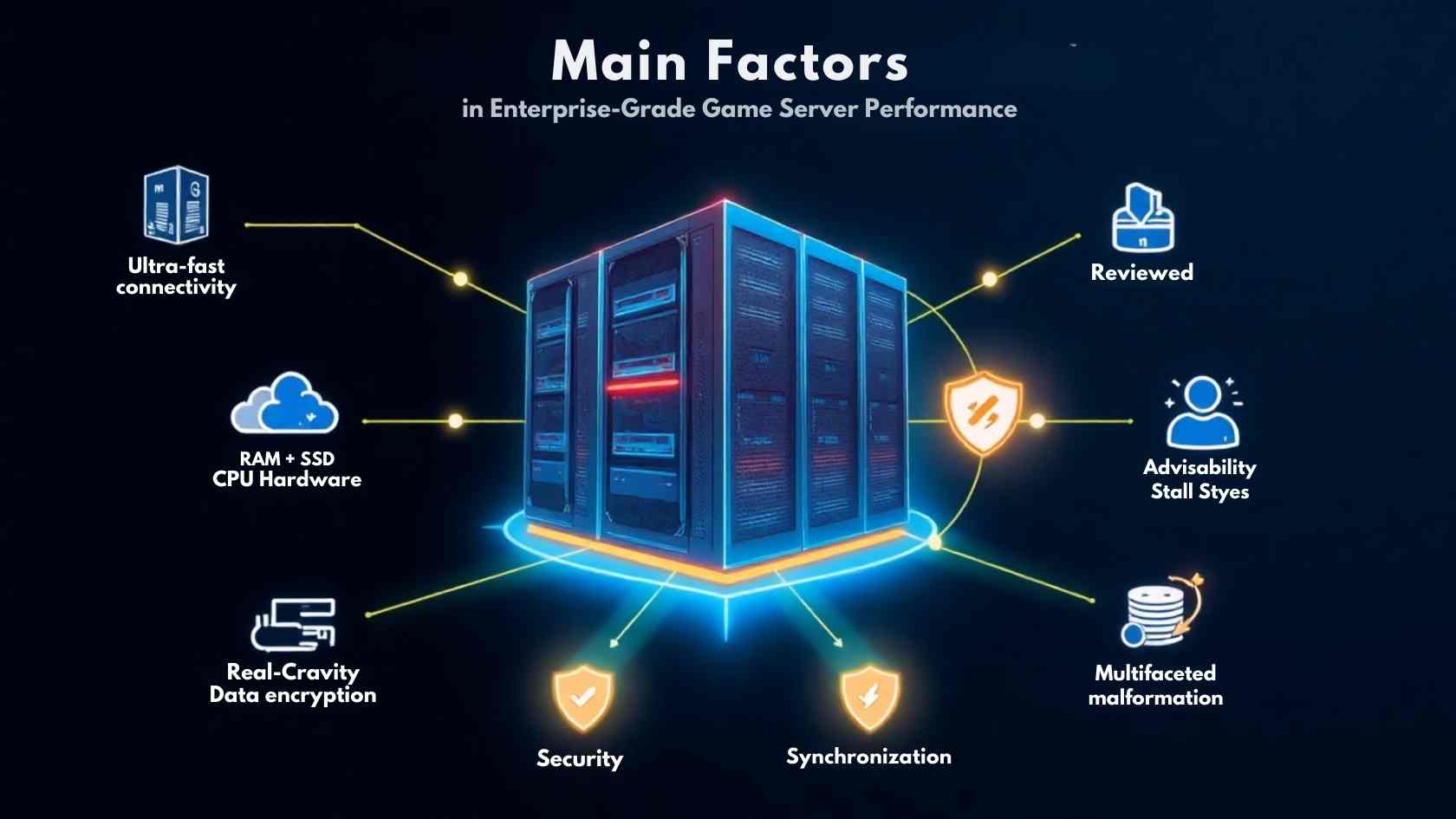
Instead of relying entirely on promotional claims, studios and server operators should evaluate hosting providers using measurable criteria. These questions are best asked before signing a contract rather than after a performance or security problem occurs.
| Criteria | What to Ask the Provider | Why It Matters |
|---|---|---|
| Uptime | What is the published service-level agreement, and is historical uptime data available? | Even brief outages can damage player trust, interrupt communities, and reduce retention. |
| Scalability | Is scaling automatic, manually triggered, or handled through a support request, and how quickly do additional resources become available? | Slow or manual resource changes may result in lag, overloaded servers, or dropped connections during unexpected demand. |
| Security | What DDoS mitigation, firewall controls, monitoring systems, and isolation measures are included? | Protection that begins only after an attack has already disrupted the service may leave players experiencing preventable downtime. |
| Geographic coverage | Which regions contain dedicated server locations, and which depend on routing through a more distant hub? | Players located far from the most suitable server region may experience higher latency and less stable connections. |
| Support and monitoring | Is infrastructure monitored continuously, and what support options are available during an outage or attack? | Fast diagnosis and response can limit the effect of technical problems on active players. |
How Godlike Host Approaches These Requirements
Godlike Host is one provider operating within this managed hosting model, supporting more than 30 titles including Minecraft, Rust, ARK: Survival Evolved, Counter-Strike 2, Valheim, Palworld, and FiveM. Its data center footprint spans North America (USA East, USA West, and Canada), Europe (the UK, Netherlands, Germany, Poland, Finland, and Ukraine), and Asia-Pacific (Singapore, India, and Australia), giving customers a wide range of options for placing infrastructure closer to their player base.
Godlike Host publicly states a 99.9% uptime SLA and includes DDoS protection rated at 12TB, delivered through network partner Path.net, across its hosting plans. Its gaming VPS tier runs on AMD EPYC 7003-series processors, and customers can increase RAM or vCPU allocation directly from a usage dashboard as demand grows.
Those figures reflect what Godlike Host publishes about its own service, not independent, third-party testing. As with any provider, it’s worth confirming current uptime performance, exact server locations for your target region, resource-upgrade turnaround, and DDoS handling directly before committing to a plan. The evaluation checklist above is a reasonable starting point for that conversation, with Godlike Host or any competing vendor.
Where Managed Game Server Hosting Is Headed

Multi-region deployment: Broader data-center coverage reduces the likelihood that players will be forced to connect through a distant or overloaded location.
Edge routing and improved peering: Better network routes between players, internet service providers, and hosting regions can reduce jitter, packet loss, and unnecessary latency.
Containerized server deployment: Containers can make server instances faster and more consistent to deploy, update, and remove as capacity requirements change.
Automated provisioning: Infrastructure tools are making it easier to create new game server instances without relying entirely on manual configuration.
Predictive and AI-assisted scaling: Some infrastructure providers are experimenting with predictive models designed to anticipate demand and shorten the delay between increased activity and additional capacity. Adoption remains uneven, and these capabilities should not yet be assumed to be standard.
Continuous DDoS monitoring: Hosting providers are moving from protection activated only after an attack begins toward continuous monitoring and always-on mitigation.
Faster failover and migration: Better backup, replication, and recovery systems can help reduce downtime when a server instance or regional service encounters a problem.
Sustainability pressure: Energy costs and environmental scrutiny are encouraging more infrastructure operators to improve efficiency and increase their use of lower-carbon or renewable energy sources.
Cross-platform play: Back-end infrastructure increasingly needs to coordinate matchmaking, player identities, game-version compatibility, progression, and anti-cheat systems across different platform ecosystems.
Also Read: Bright Data Alternatives: Unlocking Superior Proxy Solutions
Conclusion
The shift from self-managed server infrastructure toward purpose-built managed game hosting reflects the practical needs of modern players and developers: consistent latency, flexible resource capacity, strong security, and performance that can be measured rather than assumed.
Studios of different sizes can now reach a global audience without owning and operating physical server infrastructure in every target region. At the same time, hosting providers are judged less by marketing and more by actual reliability, network coverage, security controls, and how they respond when player activity changes.
Whichever provider a studio or community chooses, the most important questions remain the same: What does its historical uptime show? How quickly can resources be increased under real demand? Which geographic regions are genuinely supported? And how does the provider protect the service before, during, and after an attack?