The latest breakthroughs in quantum computing 2024 mark the most significant year in the technology’s history. After decades of laboratory experiments and cautious predictions, 2024 was the year quantum computing moved from controlled scientific settings into real commercial environments.
In this guide, you will learn what changed, why it matters, and what it means for industries ranging from finance to cybersecurity. No engineering background is required. From advances in quantum error correction to growing business adoption and stronger cybersecurity standards, the year’s progress showed that quantum computing is steadily moving beyond research laboratories and closer to practical use.
Below, we cover the seven most significant latest breakthroughs in quantum computing 2024, explained in plain English.
Key Takeaways
- Quantum error correction hit a historic new threshold in 2024.
- Logical qubits moved from theory to real laboratory demonstrations.
- Quantum computers began showing measurable ROI in finance and logistics.
- Post-quantum cryptography became a legal compliance requirement for organisations.
- Global quantum computing investment reached a record $2 billion in 2024.
What Is Quantum Computing? A Quick Primer
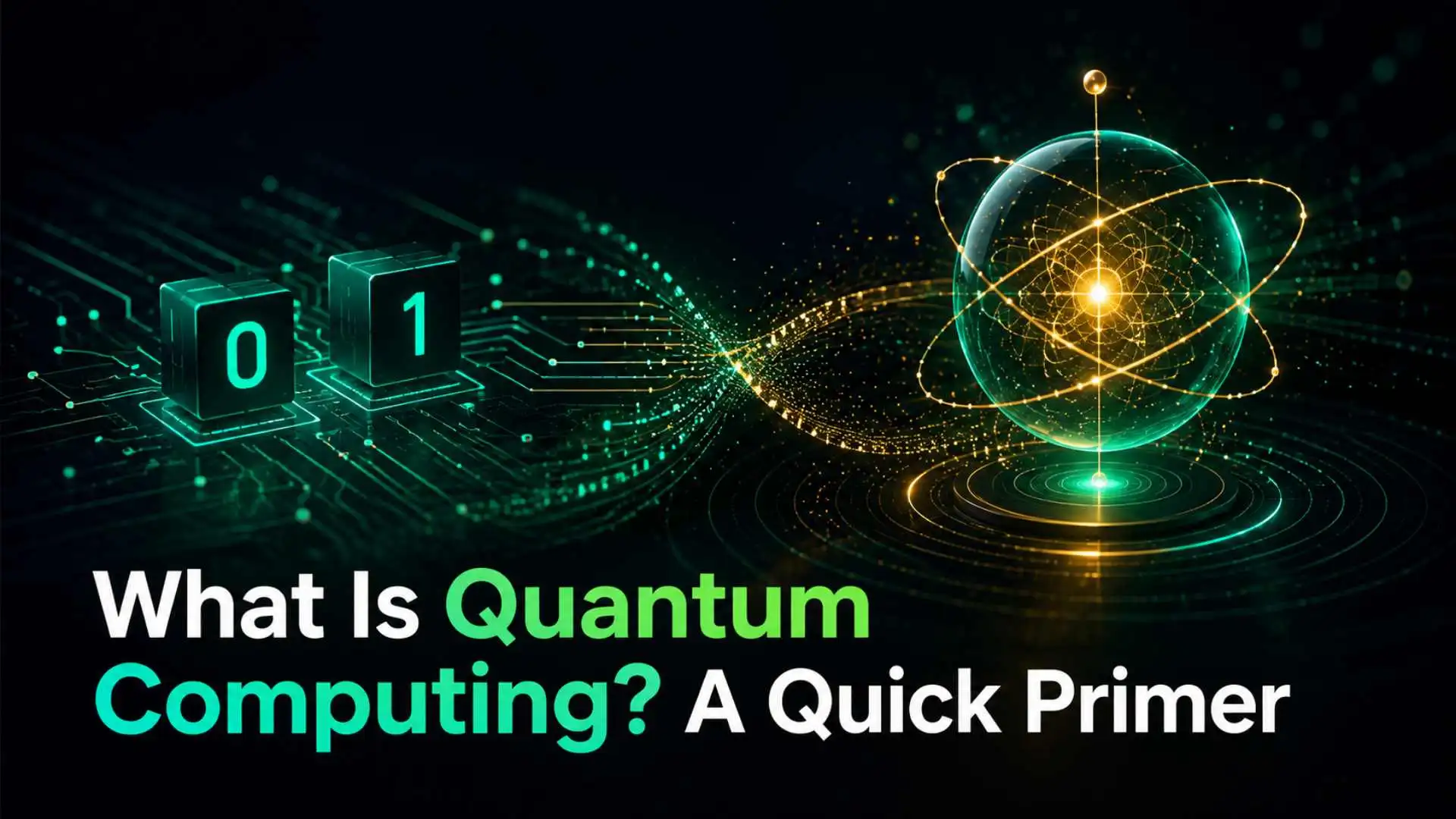
Classical computers store and process information as bits. Every bit holds exactly one value at any given moment: either a 0 or a 1. That simple on-off logic has powered everything from early calculators to today’s smartphones.
Quantum computers work differently. Their basic unit of information is called a qubit. A qubit can be a 0, a 1, or both values simultaneously. Physicists call this property superposition. Imagine flipping a coin. While the coin is still spinning in the air, it is neither heads nor tails. It exists as both possibilities at once. A qubit behaves the same way until a measurement forces it to settle on one value.
It is important to be clear about what this does not mean. Quantum computers are not universally faster than classical machines. They are built to outperform classical systems at specific problem types: large-scale optimisation, molecular simulation, cryptographic analysis, and other tasks that involve exploring enormous numbers of possible combinations at the same time.
For most of the past decade, quantum processors were grouped into a category researchers called the NISQ era, short for Noisy Intermediate-Scale Quantum. These machines had too many errors to be commercially reliable. 2024 marks the shift away from that era, toward an era focused on error-corrected, dependable quantum computing. That transition is what makes the breakthroughs below worth your attention.
What Are Latest Breakthroughs in Quantum Computing in 2024
Quantum computing advances in 2024 were not driven by a single announcement. They reflected a broader shift in how the industry measured progress, moving beyond raw qubit counts to a stronger focus on reliability, practical applications, and commercial adoption.
Key developments that defined 2024 include:
- Nearly $2 billion invested globally in quantum computing, representing approximately a 50 percent increase over the $1.3 billion invested in 2023.
- A McKinsey 2024 report found that 55 percent of quantum technology leaders reported active production use cases, up from 33 percent the previous year.
- The industry’s focus shifted from how many qubits a processor contains to how reliably those qubits perform, making quality more important than quantity.
Here are the seven most important latest breakthroughs in quantum computing 2024.
Breakthrough 1: Quantum Error Correction Reaches a Historic Milestone
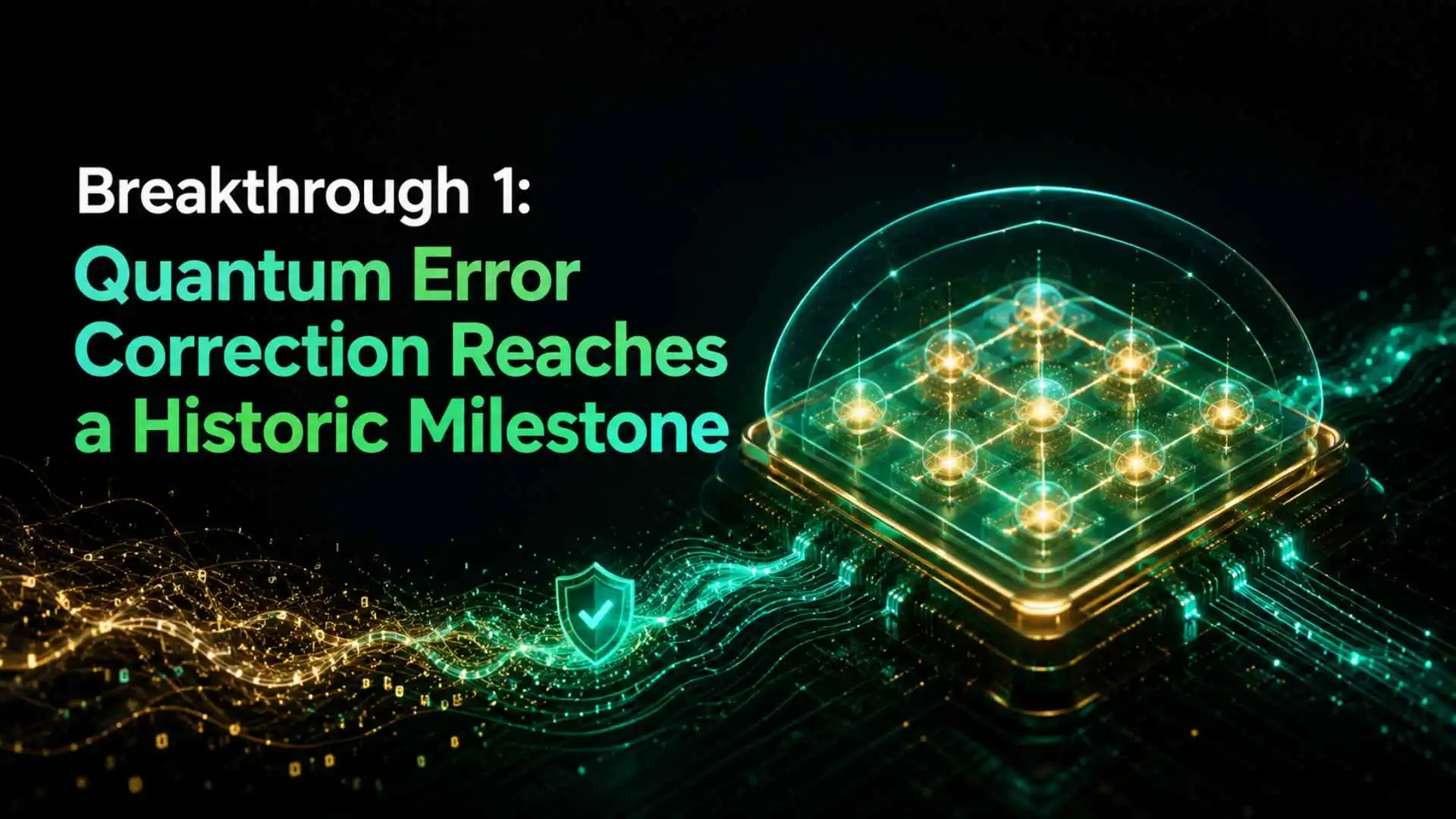
To understand this breakthrough, you need to understand the core problem with quantum computing. Quantum processors are extremely sensitive to interference. Heat, vibration, and electromagnetic noise all introduce errors into calculations. The more qubits a processor has, the more errors accumulate.
Error correction is the technique researchers use to detect and fix those errors automatically, without stopping the computation. The challenge is that adding more qubits has historically added more errors at the same time.
In December 2024, Google researchers published a landmark result showing that adding more qubits to a quantum processor actually reduced error rates rather than increasing them. This achievement, known as below-threshold error correction, had been a theoretical target for more than two decades. In simple terms, it means that adding more carefully managed qubits helps reduce mistakes instead of creating more of them. This gives researchers confidence that larger quantum computers can become more reliable as they continue to scale.
This result is widely regarded as one of the most significant latest breakthroughs in quantum computing 2024. It proves that scaling quantum processors is the correct path forward, not a dead end. It is the foundational step toward a fully fault-tolerant quantum computer capable of solving real-world problems reliably.
Also Read: The Future of Learning: AI & Machine Learning in Education Software
Breakthrough 2: Logical Qubits Move From Theory to Reality

A physical qubit is the raw hardware of a quantum computer. It is unstable by nature. A logical qubit is a layer built on top of multiple physical qubits that work together to detect and cancel out each other’s errors. The result is one reliable qubit constructed from many unreliable ones.
Creating a logical qubit that actually performs better than its physical components has been one of the hardest challenges in quantum computing. In 2024, multiple independent research teams achieved exactly that.
Some experiments demonstrated logical qubits with error rates hundreds of times lower than the physical qubits they were built from. That ratio improvement is staggering. It means that quantum circuits can now run reliably for long enough to carry out meaningful calculations.
This quantum computing milestone 2024 removes one of the last major theoretical barriers between today’s prototypes and tomorrow’s practical machines. Building a fault-tolerant quantum computer is increasingly viewed as an engineering challenge, reflecting the steady progress made in quantum hardware and error correction.
Breakthrough 3: Quantum and AI Integration Accelerates
One of the most watched quantum computing news 2024 stories was the growing partnership between quantum processors and artificial intelligence. Quantum computers are not replacing AI hardware. Instead, they are being used alongside classical GPUs as accelerators for specific calculations that classical chips handle inefficiently.
Quantum-enhanced machine learning models showed early but promising results in drug discovery and materials simulation. In both fields, the number of possible combinations to evaluate is too large for classical computers to handle at useful speeds. Quantum processors have the potential to explore certain search spaces more efficiently for specific types of problems, although this capability is still being actively developed.
Unified programming tools launched in 2024 let developers write code that runs across both standard computers and quantum processors without needing deep expertise in quantum physics. Hybrid quantum-AI pipelines are now the most credible near-term path to commercial quantum advantage. Most organisations will reach that advantage not through pure quantum systems, but through carefully designed combinations of the two.
Breakthrough 4: Neutral Atom Quantum Computing Scales Up
Most public attention around quantum hardware focuses on superconducting chip-based systems. But neutral atom quantum computing, a different and rapidly advancing approach, set world records in 2024 that the broader technology world largely overlooked.
Neutral atom systems work by suspending individual atoms in place using precisely aimed laser beams. Each atom acts as a qubit. The key advantage is consistency. Atoms are naturally identical to one another, which eliminates the manufacturing variation that plagues chip-based qubit production.
In 2024, researchers demonstrated over 6,000 coherent qubits in a single neutral atom array, a new world record. A separate milestone showed over 1,000 atoms loaded in a single experimental run, confirming that the approach can scale toward practical sizes.
Neutral atom systems also have a unique capability. Their hardware layouts can be reconfigured while a calculation is in progress. That flexibility gives researchers options that chip-based architectures simply do not allow.
Breakthrough 5: Real-World Applications Begin Delivering Measurable Results
In the finance sector, major European banks including Credit Agricole and BBVA successfully deployed quantum-hybrid systems to optimise financial portfolios. These systems demonstrated the ability to calculate risk for complex derivatives in seconds rather than days, a meaningful step toward commercial quantum advantage in financial services.
In logistics, a corporate partnership between Japanese technology firm Groovenauts and Mitsubishi Estate used quantum-optimised routing to reduce operational inefficiencies in real-world delivery networks, representing one of the most concrete logistics deployments of hybrid quantum computing recorded in 2024.
A McKinsey 2024 report found that 55 percent of quantum technology leaders reported active production use cases, up from 33 percent the previous year. These real-world applications represent one of the latest breakthroughs in quantum computing 2024, showing how hybrid quantum systems are beginning to create measurable business value. It is important to be precise about what these results represent. These are hybrid quantum-classical outcomes, not pure quantum advantage. A quantum processor alone did not produce them. Pure quantum advantage at commercial scale is still estimated to be five to ten years away.
Also Read: Quack AI Governance: The AI Protocol Powering Next-Gen Web3 Governance
Breakthrough 6: Post-Quantum Cryptography Becomes an Official Standard

2024 quantum computing progress extended well beyond hardware. The United States National Institute of Standards and Technology, known as NIST, finalised the world’s first official post-quantum cryptography standards. This was one of the most consequential regulatory events in the history of digital security.
Post-quantum cryptography refers to encryption algorithms that are mathematically designed to resist attacks from quantum computers. Today’s encryption relies on mathematical problems that classical computers cannot solve efficiently. A sufficiently powerful quantum computer could crack those problems in hours.
NIST standardised three algorithms in 2024, covering both key exchange and digital signatures. They are designated FIPS 203, FIPS 204, and FIPS 205.
The reason this matters now, rather than when the threat actually arrives, is the migration timeline. Switching an organisation’s encryption infrastructure takes five to ten years. A quantum computer capable of breaking current encryption is still estimated to be seven to fifteen years away. But that gap is narrowing, and governments and regulated industries in finance, healthcare, and defence are already beginning to mandate quantum-safe encryption timelines.
The practical advice for any organisation handling sensitive long-term data is straightforward: begin a cryptographic inventory audit today. Know which systems use which encryption, and begin planning for migration.
Breakthrough 7: Quantum Computing Investment Hits a Record High
$2 billion was invested globally in quantum computing in 2024. That is the highest single-year total in the technology’s history and nearly double the 2023 figure.
Funding went to three main areas: quantum hardware startups pushing the boundaries of qubit performance, quantum software companies building the tools developers will need, and hybrid classical-quantum platform developers creating the infrastructure for near-term commercial use.
The signal is clear. Venture capital and enterprise investors now view near-term quantum ROI as a credible financial bet, not a speculative long-shot. That shift in investor confidence will accelerate development timelines and talent recruitment across the entire sector.
What Challenges Still Remain?
Despite the remarkable progress made in 2024, several important challenges remain before quantum computing becomes widely practical.
- High error rates: Quantum processors still make far more errors per operation than classical computers, even with recent advances in quantum error correction.
- Extreme cooling requirements: Most quantum processors must operate at temperatures near absolute zero, making the cooling infrastructure expensive, physically large, and difficult to maintain.
- Scaling reliable qubits: Connecting thousands of reliable qubits without significant signal loss remains one of the biggest engineering challenges.
- Skills gap: Relatively few software developers know how to program quantum computers, and mainstream quantum software tools are still maturing.
- Commercial timeline: Practical, large-scale quantum advantage for everyday commercial problems is still believed to be several years away, although estimates vary across the industry.
What to Expect Next: The Quantum Computing Roadmap to 2030

Looking at the quantum computing roadmap, 2025 and 2026 are expected to bring the first demonstrations of logical qubit processors running real-world problem circuits at scale. Quantum-safe encryption mandates are expected to expand across government and financial sectors. Neutral atom research teams are targeting arrays of 10,000 or more qubits.
Between 2027 and 2030, commercially viable fault-tolerant quantum computing systems could begin emerging, although timelines will depend on continued advances in hardware, error correction, and investment. Quantum networking, including secure communication links between cities, is expected to see further demonstrations. The first applications in pharmaceutical drug discovery and advanced materials design may begin delivering results that classical computers could not achieve alone.
Also Read: Most Effective Methods to Recover a Corrupted SQL Database
Conclusion
The latest breakthroughs in quantum computing 2024 represent a genuine inflection point. Error correction crossed a historic threshold, logical qubits moved from theoretical constructs to laboratory demonstrations, real-world applications began demonstrating measurable value, and global investment hit a record high.
This is no longer a technology confined to research laboratories. It is increasingly being explored through real-world pilots and early commercial applications. The questions now are not whether quantum computing will matter, but when and in which industries it will matter first.
Bookmark this page. It is updated regularly as new milestones emerge.
Last Updated: June 2026
Frequently Asked Questions
What were the biggest breakthroughs in quantum computing in 2024?
2024 saw historic progress in quantum error correction, logical qubit creation, and real-world hybrid applications. Global investment reached nearly $2 billion, and 55 percent of quantum technology leaders reported active production use cases for the first time.
What is quantum error correction and why does it matter?
Quantum error correction uses groups of physical qubits to detect and fix each other’s errors automatically. Without it, quantum calculations collapse before completing. A 2024 milestone showed that carefully scaling error-corrected quantum systems can reduce error rates, marking an important step toward fault-tolerant quantum computing.
What is a logical qubit?
A logical qubit is a reliable qubit built from multiple physical qubits that work together to cancel out errors. In 2024, research teams demonstrated logical qubits with error rates hundreds of times lower than the physical qubits they were built from.
What companies are leading quantum computing in 2024?
Leading organisations include Google, IBM, Microsoft, Quantinuum, QuEra, PASQAL, and IonQ, alongside academic labs at Caltech and MIT. Each uses a different hardware approach, including superconducting circuits, trapped ions, and neutral atoms.
Is quantum computing a threat to encryption right now?
Not yet. Today’s quantum computers cannot break modern encryption. However, NIST finalised post-quantum cryptography standards in 2024 because a capable quantum computer is estimated to be seven to fifteen years away, and migration takes equally long to complete.
When will quantum computers be available for everyday use?
Cloud access is already available through IBM Quantum, AWS Braket, and Azure Quantum. However, fault-tolerant quantum computers that consistently outperform classical systems on practical tasks are estimated to be seven to fifteen years away.
What is post-quantum cryptography?
Post-quantum cryptography refers to encryption algorithms designed to resist quantum computer attacks. In 2024, NIST published three official standards, FIPS 203, 204, and 205, and governments are beginning to mandate their adoption across regulated industries.