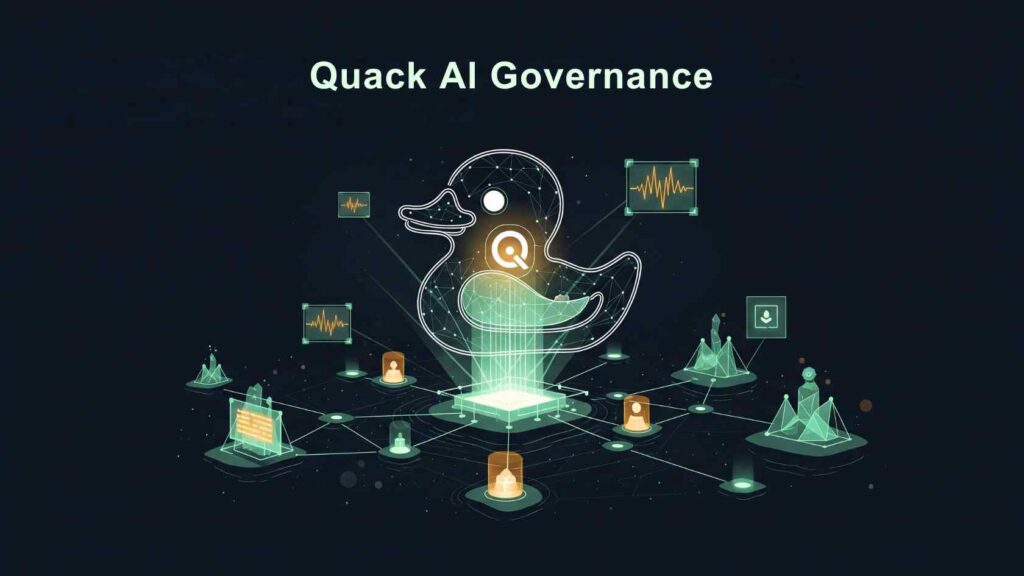
In the rapidly evolving world of artificial intelligence (AI), organizational frameworks are crucial. They help in confirming that AI manifestations are created and utilized effectively. Quack AI Governance is an unused concept. It oversees the uncommon challenges and opportunities that AI brings. This article jumps into Charlatan AI administration.
It covers the principal standards and components, as well as why they are critical. It also looks at its impacts on businesses and society.
What Is Quack AI Governance?

Quack AI Governance is the first AI-driven governance protocol. It employs autonomous AI agents to analyze, score, delegate, and carry out DAO operations. This occurs transparently across multiple blockchain ecosystems.
It’s an infrastructure layer that changes governance. It transforms a slow bottleneck into a fast, data-driven resource. This is useful for any Web3 protocol or Real-World Asset (RWA) tokenization project.
Why Web3 Governance Needs a Makeover
Quack AI Governance explores key issues in recorded Decentralized Autonomous Organizations (DAOs). The cases are low voter turnout, slow performance, and the influence of large token collectors, known as whales.
DAO governance, while conceptually sound in its structure, is practically ineffective. Many structures face “governance apathy.” Less than 10% of token holders vote. This ends in slow decision-making. As a result, a few large accounts hold most power. The voting process can be slow. It often takes weeks to accept important suggestions. This intricacy leads to “voter fatigue.”
A Step-by-Step Guide to Quack AI Governance

Quack AI does not return people; rather, it improves the network through smart AI. This makes leadership faster, more pleasant, and less demanding for workers. The strategy shifts from manual or AI-assisted proposition generation to automatic, on-chain performance.
Step 1: Proposal Creation & Import
The governance cycle starts with a proposal. Quack AI makes it easy. Unlike traditional DAOs, users don’t have to write complex documents.
- Manual Settlement: A community participant submits a routine proposal by means of the DAO gathering. The AI instantly ingests, summarizes, and contextualizes the document.
- AI-Generated Suggestion: The AI makes referrals by exploring, promoting data, treasury prosperity, and community needs. If the AI recognizes a critical exhibit move, it can rapidly draft a recommendation. Join contrasting reduction rates or shifting treasury support to direct change.
Step 2: AI Analysis & Scoring
This is the central knowledge region, where the AI shows up and the scoring engine takes over. After a suggestion is submitted, the AI performs a comprehensive, objective evaluation.
- Risk Examination: The AI analyzes the proposal’s code, monetary suggestions, and execution courses of action. It looks for vulnerabilities and potential misuse. It, in expansion, evaluates the protocol’s liquidity and dissolvability impact.
- Relevance & Course of Activity: This takes after the organization based on the DAO’s mission. It looks at past organization choices and community input from social events, social media, and on-chain actions.
- Prioritization & Scoring: Each proposal brings a clear score. This solidifies a “Chance Score,” “Achievability Score,” and “Community Advantage Score.” This data-driven encounter makes a distinction between human voters and AI masters.
Step 3: Assigned or Manual Voting
Quack AI brings an unusual way for someone to get included. Its AI assignment demonstrates voters’ lack of concern and diminishes whale dominance.
- Delegated Voting: Token holders can pass their administration rights to an AI operator or a human designate. The client sets their key inclinations. They can choose a “most hazard resilience” procedure or a “DeFi growth-oriented” one. The AI operator works on the blockchain. It casts votes in real time for the client. It matches their inclinations with AI-driven proposition scores.
- Manual Voting: Clients who need coordinated control can vote physically. They can utilize the AI’s scoring and summarization devices for support. This guarantees human judgment remains the last moral and imaginative layer.
Step 4: On-Chain Execution Over Chains
Once a suggestion is embraced, the execution is steady, robotized, and tamper-proof.
- Smart Contract Execution: When proposals are confirmed, like changing a traditional parameter or releasing treasury stores, smart contracts sanction rights away. This accounts for the weeks-long delays and human botch threats related to manual execution.
- Cross-Chain Execution: Charlatan AI is built with multi-chain compatibility. Its organization administrators and canny contracts can select and act on different blockchain frameworks, like Ethereum, BNB Chain, Solana, and Arbitrum. This happens by means of a single organization interface, setting the Web3 natural systems’ divisions.
Step 5: Criticism & Learning
The handle is a ceaseless cycle of learning and advancement. This way, the model gets to be way better with each cycle.
Review Logs & Straightforwardness: The AI records each movement on-chain. This joins the beginning score, the last vote, and the execution. This makes a clear, unchangeable way that can be assessed. This verifiable logic is fundamental for trust.
- AI Administrator Refinement: The AI appears to offer a peek at the result of voted suggestions. In this case, it checks if the protocol’s TVL is extended after a choice.
- Treasury Stream Mechanization: The AI oversees treasury stores. It moves assets between chains to optimize yield or reduce risk. It always follows community-approved parameters.
Key Benefits of Quack AI Governance for DAOs & Protocols

Quack AI addresses the core structural and operational challenges facing modern decentralized organizations.
1. Increased Participation & Fairness (Whale Mitigation)
The AI Delegation model boosts participation rates. It does this by cutting down the time required. Non-participating token holders can let an AI specialist vote for them. This specialist looks out for their financial interest. They simply create mystery to stay dynamic in administration.
Quack AI can produce more appealing results by using preference-based designation. It weighs votes with more than a fair token number, like confirmed commitment records. This approach makes a difference in diminishing the impact of expansive token holders.
2. Speed & Automation
In fast-moving DeFi and Web3 markets, “governance lag” is a critical liability. Quack AI transforms this:
- Real-Time Proposal Analysis: Hours of research turn into seconds. The AI delivers quick, data-driven summaries and scores.
- Instant Execution: Smart contracts automatically execute approved proposals. This cuts out human delays and lets the protocol respond quickly to market changes. Decisions that once took weeks now take minutes.
3. Cross-Chain Governance & Unified Infrastructure
Quack AI provides a singular governance framework that spans multiple chains. Quack AI allows one vote to activate actions on multiple chains, such as Ethereum, Arbitrum, and BNB Chain. It works for protocols at various layers. It essentially unifies fragmented ecosystems and eliminates the need for complex, multi-layered governance procedures.
4. How Quack AI Governance Differs from Traditional AI Governance
Traditional AI governance often emphasizes compliance and fixed rules. This approach can become outdated quickly as technology evolves. Quack AI Governance differs by:
- Prioritizing flexibility and knowledge enables the administration to advance local AI technologies.
- Focus on communication and cooperation among partners. Think of it like “quacking” to emphasize the significance of progressing feedback.
- Integrating both moral and specialized measurements seamlessly.
- Addressing governance with a progressive approach rather than a one-time checklist.
5. Implementation Challenges of Quack AI Governance
While Quack AI Governance offers a promising roadmap, its implementation comes with challenges:
- AI systems can be complex. This makes it troublesome to see how they work and to clarify their decisions.
- Resource objectives: Little and medium-sized wanderers regularly require the staff or budget for full governance.
- Global coordination: It’s strongly altering the organization around the world. Assorted legitimate and social benchmarks make it challenging.
- Balancing progression and control: Overregulation can cover creativity, though underregulation raises risks.
- Tackling these challenges needs collaboration among governments, businesses, and schools. They must share their best homes and resources.
Case Studies Illustrating Quack AI Governance

Healthcare AI Systems
A hospital using AI for diagnostics chose Quack AI Governance. This tool helps monitor bias in disease prediction algorithms for different demographic groups. It improved fairness by adjusting models and data sources. This change came from constant assessments and feedback from stakeholders. As a result, it gained patient trust and regulatory approval.
Financial Services
A bank added Quack AI Governance. It built clear systems so customers can understand loan decisions. It set up accountability protocols. This way, errors or biases in AI credit scoring can be fixed, still in line with economic rules.
Smart Cities
City authorities using AI for surveillance and traffic control follow Quack AI Governance. This makes a useful difference in securing citizen security and advances transparency in information utilization. Normal reviews and citizen interviews kept the administration responsive and adjusted with an open interface.
What’s Next? Future of Quack AI Governance
Quack AI aims to be the main backbone for big, decentralized decisions in Web3.
- Roadmap Climb: Agent Upgrades and RWA Integration
Plans will boost AI agents’ intelligence and skills. This includes advanced AI-optimized treasury management and dedicated RWA. They can automatically connect with real-world legal and financial data feeds. - Trends: Governance Infrastructure Becomes Baseline for DAOs: The market is shifting. It is migrating from complex governance systems to modular, plug-and-play infrastructure. Quack AI aims to be the standard. Its flexibility lets protocols use specific functions like proposal scoring or charging. Additionally, it occurs without the need for a complete migration.
This makes it the primary governance layer for the next generation of multi-chain DAOs and world-class RWA platforms.
Also Read: Beyond the Bot 8 Uses of Conversational AI in the Real World
FAQs
What Token Powers Quack AI governance?
The governance token for Quack AI is called $AIQ or Q. Token holders stake it to secure the network. They get governance access, delegate rights to AI agents, and earn rewards from protocol fees.
How does Charlatan AI on-chain Voting Work?
Quack AI permits token holders to vote straightforwardly. They can also appoint their voting control to AI specialists. The AI operators vote based on the user’s set inclinations and real-time information. This guarantees keen interest that is forever recorded on the blockchain.
Is Quack AI Live on Multiple Blockchains?
Yes. Quack AI serves as a chain-neutral governance layer. It has modules and agents that can make decisions in different blockchain ecosystems. These include Ethereum, BNB Chain, Solana, Arbitrum, and more
How Does Quack AI on-chain Voting Work?
Token holders can vote directly or let an AI agent vote for them. The AI uses the user’s preferences and analyzes real-time data to make decisions.
Is Quack AI Live on Multiple Blockchains?
Yes, Quack AI works on different chains. It connects well with major ecosystems like Ethereum, BNB Chain, Arbitrum, Linea, and more.
Conclusion
Quack AI governance represents a crucial evolutionary step for Web3. It addresses the imperfections in first-generation DAOs. Utilizing AI includes speed, reasonableness, and versatility in decentralized decision-making.
Charlatan AI shows how future organizations can work. It mechanizes data-heavy errands while keeping human judgment for methodology and morals. This approach makes decentralized, proficient, and compliant frameworks. It is not a fair instrument for voting; it serves as a foundation for independent, shrewd coordination.