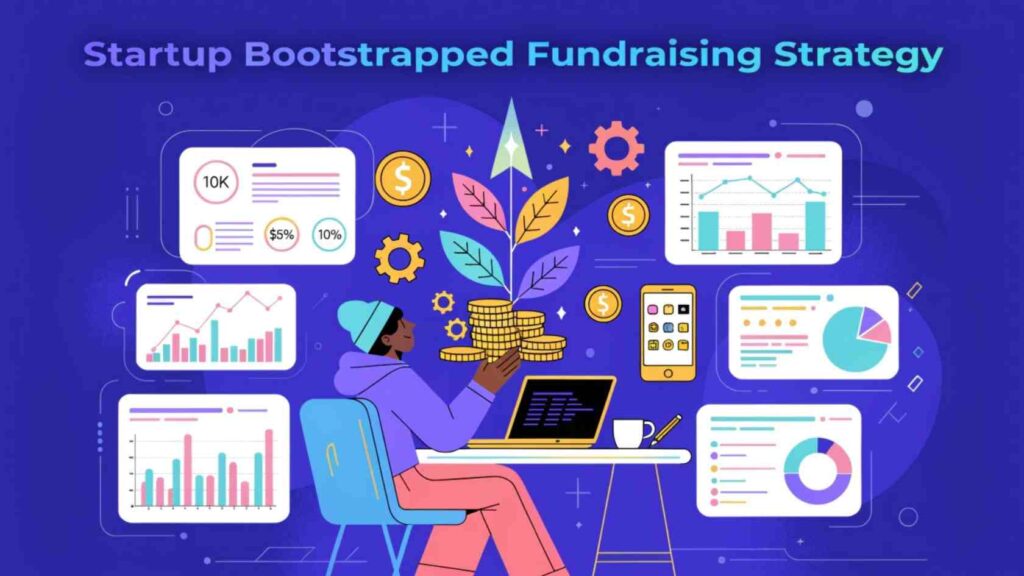
A booted fundraising strategy focuses on revenue first. It helps businesses grow efficiently with little outside funding. Founders focus on customer revenue, personal savings, and non-dilutive options. They do this instead of chasing big VC rounds early. This approach enables financial growth, maintains control, and builds sustainable unit economics.
This method will be the preferred approach for founders in 2025–2026. It helps founders avoid investor pressure, excessive dilution, and excessive spending.
What Is a Startup Booted Fundraising Strategy?
The startup Booted Fundraising Strategy is a hybrid funding model. In this model, a company grows by using income, founder capital, and a small amount of outside funding. It only looks for investors when it has clear metrics, earnings, or strong traction. It falls between full venture capital funding and conventional bootstrapping.
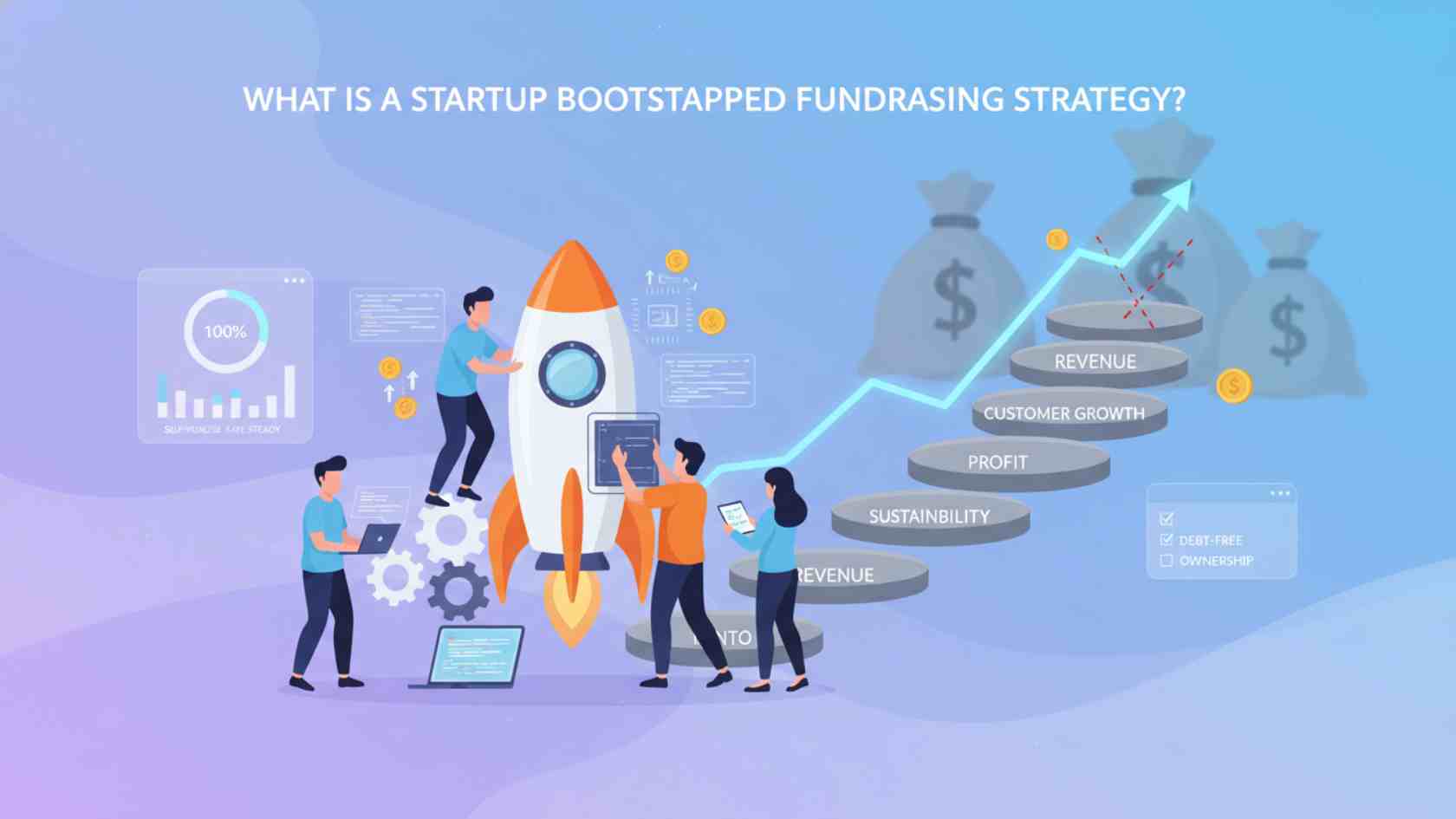
Founders using this strategy rank customers to boost revenue growth. They focus on this before pursuing outside investment. It does this by prioritizing customers, then seeking external investment. This approach keeps ownership strong while improving unit economics early. As a result, founders can raise funds with confidence rather than desperation.
Booted Fundraising vs Bootstrapping vs VC
| Model | Funding source | Equity impact | Growth speed |
| Bootstrapping | Personal savings, revenue | No dilution | Slow |
| Booted Fundraising | Revenue + small funding | Low dilution | Steady |
| Venture Capital | Investors | High dilution | Fast |
Booted fundraising doesn’t mean saying no to funding forever. It’s about waiting to dilute shares. This should happen when the business has high demand, good margins, and real leverage.
Why Founders Are Choosing Booted Fundraising in 2026
Since 2024, there has been a tightening of the venture capital markets. These days, later-stage rounds are smaller. Founders face two tough challenges: higher performance expectations and more board oversight. Compared to VC-funded businesses, bootstrapped entrepreneurs rank turning a profit. Businesses supported by venture capital depend heavily on outside funding. About 35% of firms with significant venture capital funding turn a profit.
Key reasons founders are moving toward booted fundraising strategy:
- Dilution can damage long-term wealth. Giving up 15–25% of equity too soon may cost founders millions when the business grows.
- VC demands hypergrowth. Investors want rapid scaling. This often means aggressive hiring and costly marketing. This often pushes break-even far into the future.
- Sustainable businesses outlast hype-driven growth. A revenue-first strategy supports profitability, strong unit economics, and long-term stability.
In today’s post-bubble market, these qualities matter more. Founders now value customer traction over pitch decks.
How Startup Booted Fundraising Strategy Works
Step 1 – Validate a Real Problem
Founders check if people need their solution before writing code or hiring a team. This includes pre-orders or paid pilots, surveys, landing-page tests, and interviews. If nobody pays or commits, the idea likely lacks product-market fit at this stage.
- Test with a small group of 20–50 target users
- Ask: “Would you pay for this today?” and track real intent (e.g., prepayments)
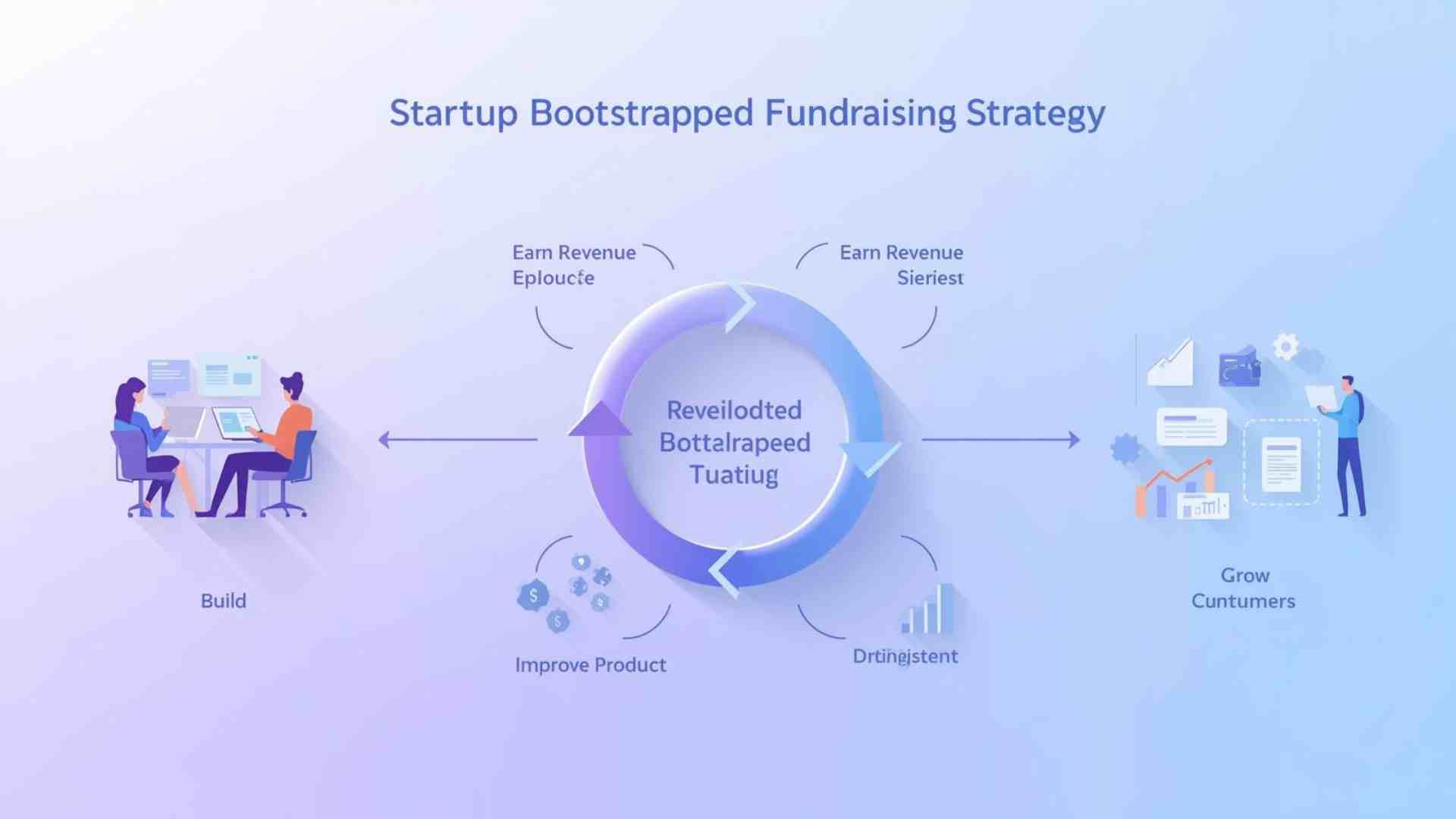
Step 2 – Build a Revenue‑Generating MVP
A booted MVP is not a “free beta” but a paid offering with the smallest set of features that solves the core problem. Charge early, even for simple products. Revenue is the main source of funding.
- SaaS founders usually begin with one plan, a small number of users, or time-limited trials.
Step 3 – Get Early Paying Customers
Early paying customers are the lifeblood of a bootstrapped strategy. Founders focus on these strategies instead of spending heavily on ads:
- Connect with specialist communities, LinkedIn, and email.
- Offer top-notch services or manual onboarding for feedback.
These clients help make money. They also improve pricing, messaging, and retention.
Step 4 – Reinvesting Revenue
Every dollar earned contributes to the future. Save money by hiring remote workers. Use affordable equipment and skip costly office space.
Reinvest mainly in:
- Boosting the reliability and quality of the product.
- Completing the customer acquisition loop by improving onboarding, retention, and support.
This helps avoid a ‘burn-and-hope’ growth model. Instead, you build a capital-efficient growth loop.
Step 5: Grow Sustainably
Scaling in a booted model means growing within margins, not beyond them. Founders:
- Add capacity only when the current revenue can cover the incremental cost.
- Adjust pricing, packaging, and upsells to boost lifetime value. Avoid cutting prices for quick growth
This usually leads to slower but more durable growth.
Revenue-First Growth Model Explained
In a booted environment, customers pay for growth, not investors. The model hinges on clean unit economics:
-
- Customer Acquisition Cost (CAC): CAC = Total sales and marketing spend ÷ Number of new customers gained.
- Customer Lifetime Value (LTV): TV = Average Revenue per Customer ÷ Churn Rate
- Monthly Recurring Revenue (MRR) is steady income from retainers or subscriptions.
- Aim for a payback period under a year and an LTV: CAC ratio of at least 3:1 for a strong business.
When customers pay on time, the cost to get them decreases. This allows the business to grow without requiring large assets.
Real Examples of Successful Booted Startups

Mailchimp
- How they started: Mailchimp began as a side project in a web-design agency. They charged small businesses for email campaigns.
- Growth strategy: They aimed for a simple, affordable product. They used organic SEO and strong UX. They raised small amounts of external capital, but only much later.
- Key takeaway: A lengthy bootstrapped phase created a profitable, independent business. This success later led to a major acquisition.
Basecamp
- Basecamp started as 37signals. It grew through word-of-mouth and a small, efficient team
- Growth strategy: They steered clear of VC. They kept pricing simple and focused on profits instead of just rapid growth
- Key takeaway: They maintained full control and a conservative burn. This helped them stay independent and profitable for decades.
Shopify
- How they started: Shopify started as an online snowboard store. Then, it grew into a platform for other merchants
- Growth strategy: They started with bootstrapping and later raised capital. They did this only after showing that the model was successful
- Key takeaway: Start with booted development first. Then, seek selective VC funding, not the other way around
Zoho
- How they started: Zoho began with the founders’ savings and money from software for small businesses.
- They expanded product lines over time. They funded this with their profits, and they remained private.
- You can build a global enterprise-level company in a sustainable and cost-efficient manner. This approach removes the pressure to exit.
Types of Booted Fundraising Strategies
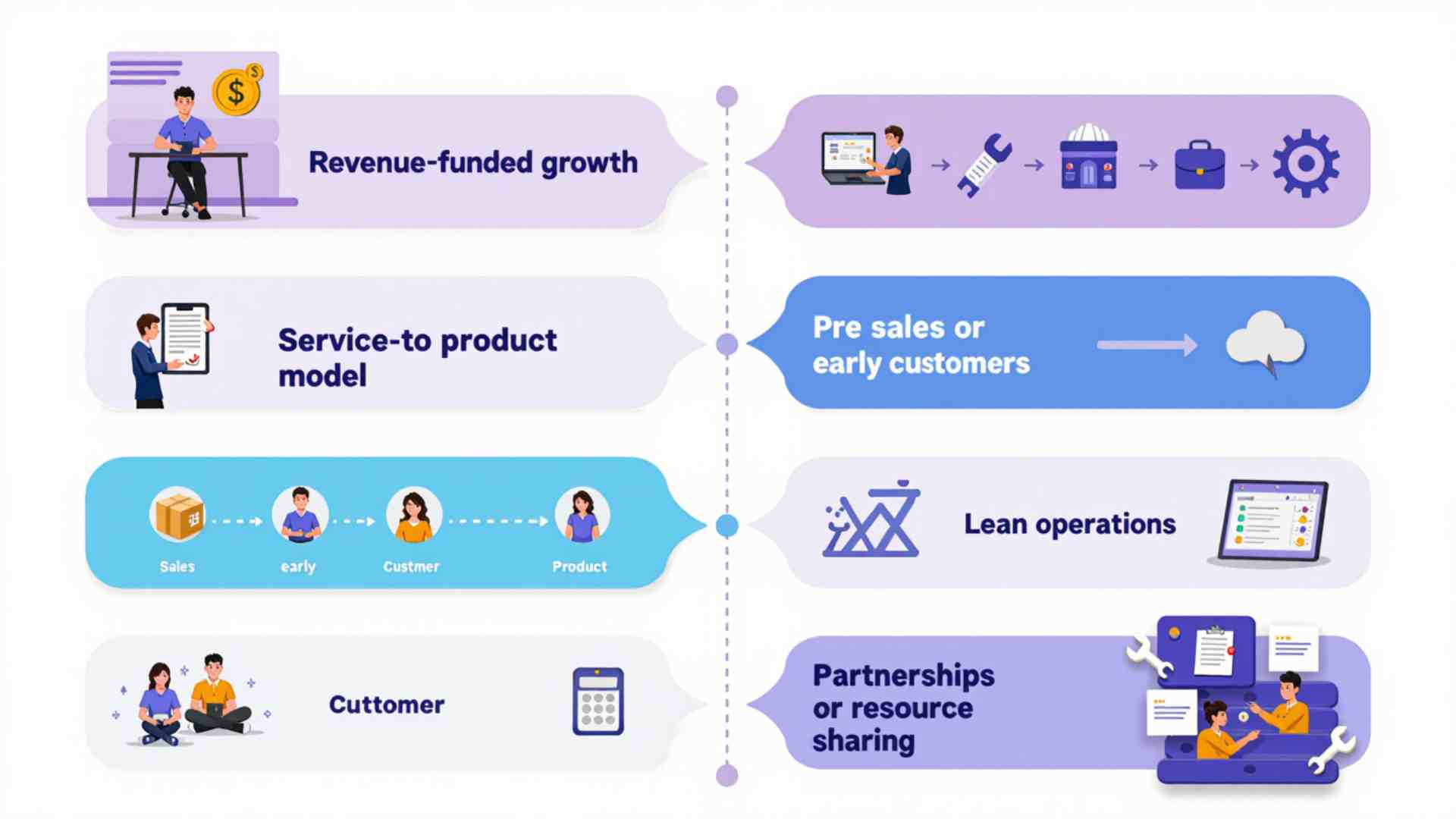
Different founders use different variants of booted fundraising:
Personal Savings:
- Use your own money, a side gig, or an inheritance to fund early growth.
- Revenue-based bootstrapping means using early client payments to fund your business. You take the extra cash and reinvest it.
- Side-hustle model: Manage the business on a part-time basis. Until your income stabilizes, continue working a full-time job.
- The lean startup model emphasizes quick testing and creating minimal viable products.
- It also encourages ongoing improvement. Spend less and get fast feedback.
Each has its pros and cons. They all have a common core: revenue or personal capital comes before outside equity.
Benefits of Booted Fundraising
Founders keep their equity and control over decision-making.
- Financial discipline: Concentrating on profitable, high-margin enterprises is necessary due to limited resources.
- Customer-driven growth: Every feature and hire comes from real demand, not investor requests.
- Long-term sustainability: In a profit-first culture, long-term survival takes precedence over short-term peaks.
Drawbacks and Unspoken Difficulties
Booted fundraising has its challenges. It can be hard, even with benefits. Growth takes time. Without enough funding, scaling up may take a while.
- Risk of Burnout: Founders frequently put in a lot of overtime. They have a lot on their plate and are under strain because they are self-sufficient.
- Missed market opportunities: VC-backed rivals can act quickly. They can capture market share quickly through aggressive pricing and spending.
- Competitive Pressure: Bootstrapped businesses struggle to compete with venture capital firms. The market is challenging because of their large client acquisition expenditures.
Founders can prepare for timing, pacing, and health by knowing these hazards.
Booted Fundraising vs Venture Capital (Deep Comparison)
| Factor | Booted fundraising | Venture capital |
| Growth speed | Gradual, within margins | Fast, often capital‑heavy |
| Control | Founder-led, minimal interference | Board-influenced, investor-driven |
| Risk | Controlled burn, lower default risk | High burn, higher failure risk |
| Profitability | Focus on early margins and sustainability | Often prioritizes growth over profit |
| Exit pressure | On your terms, when the market allows | Typically aims for large, time-bound exits. |
When Bootstrapping Fails
Booted fundraising can fail when:
- Despite the company’s efforts, churn is still significant and customers frequently postpone payments.
- Hardware, biotech, and deep tech are examples of high-capital industries. These industries frequently require large initial investments before they start to generate income.
- Poor cash flow management can hurt founders. Even if they make money, they may still fail. This happens when they hire too many employees, can’t control pricing, or take too long to raise prices.
- Spotting these warning signs early helps founders make changes, improve, or get financing.
Financial Planning for Bootstrapped Startups
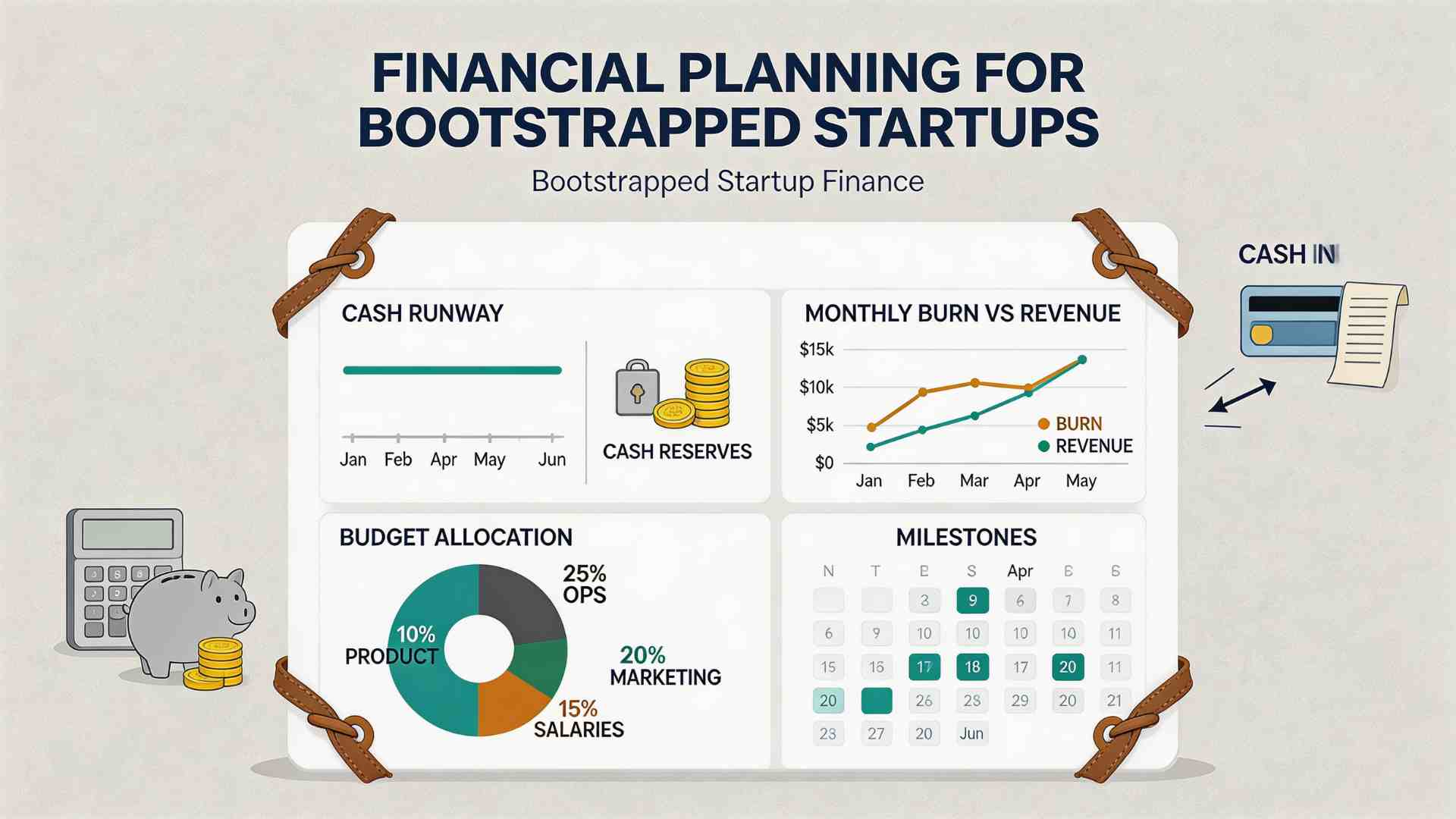
- Cash Flow Management: Check weekly inflows and outflows. Delay spending that isn’t necessary.
- Budgeting Strategies: Follow the 50/30/20 rule or zero-based budgeting. For example, divide 50% for needs, 30% for wants, and 20% for savings.
- Save six to twelve months’ worth of cash in reserves or safe investments for emergencies. This allows you to handle downturns or delays
Marketing Strategies for Booted Startups
Because booted startups can’t spend millions on ads, they rely on the following:
- SaaS, gadget, and service-based businesses experience significant advantages from long-term SEO. This strategy focuses on high-intent audiences.
- Case studies, blogs, and educational activities all foster trust while imparting insightful knowledge.
- Use Reddit, LinkedIn, Twitter/X, and specialist forums to interact with your audience.
- Word of mouth: When clients are so involved that they wish to refer others.
Key Metrics Every Founder Must Track
- MRR: MRR = ∑ Month-to-month contracts from active customers
- CAC: Aim to recover customer acquisition cost within 12 months.
- LTV: As over; target LTV: CAC ≥ 3:1
- Burn rate: Total monthly cash spent by the business
- Runway: Runway = Current Cash ÷ Month-to-month Burn
Health benchmarks in 2026:
- LTV:CAC ≥ 3:1
- CAC payback < 12 months
- Runway > 12 months for most booted startups
Best Non-Dilutive Financing Options
- Revenue-based financing: Lenders give cash in exchange for a portion of future revenue.
- Grants are funds from the government or private sources. They support new companies, especially in tech and green sectors.
- Strategic organizations: Associations with bigger companies that give forthright installments, co-development, or distribution.
These options can fund growth without early equity dilution.
Common Botches in Booted Fundraising
- Underestimating costs: Ignoring unstated costs such fees, security measures, and churn reimbursement. Some entrepreneurs rush to raise funds, but others wait until they face bankruptcy.
- Inadequate financial planning: No runway gauges, crisis plan, or well-defined budget.
- Raising too soon or too late: Investors are waiting for opportunities. They either raise funds too early or too late. Commerce is ready but may hold off until funds run low.
When Ought You Raise Outside Funding?
External funding makes sense when:
- You have solid measurements (strong MRR, low churn, sound LTV: CAC).
- Scaling requires capital for inventory, hiring, or technology.
- You’re raising from strength, not because you’re about to run out of cash.
If you want product-market fit, a bootstrapped fundraising strategy keeps you in control. It also gives you more time.
Also Read: Startup Booted Financial Modeling: A Practical Revenue-First Guide for Founders
Final Thoughts
A startup’s fundraising strategy isn’t about turning down money. It’s about earning the chance to raise funds on better terms. It emphasizes control, sustainability, and smart growth over valuations and hype. In 2026, founders rank real businesses over pleasing investors. They view booted fundraising as a smarter, long-term choice.
FAQs
What is booted fundraising?
Bootstrapped fundraising combines startup funding with founder capital. It brings in external investors later. This strategy aids entrepreneurs in maintaining control and expanding sustainably.
Is bootstrapping superior to venture capital?
Booted fundraising, or bootstrapping, is great. It helps you keep your earnings, ownership, and control over time. Choose venture financing only if you can accept the big dilution and pressure. This option helps you grow quickly.
To begin, how much money do you need?
A lot of bootstrapped companies start out with a few thousand dollars or early pre-sales. Start small and grow as your income shows success.
Can bootstrapped startups grow?
Bootstrapped firms can expand into international markets. Mailchimp, Basecamp, Shopify, and Zoho illustrate this clearly. They are successful because they emphasize sustainable growth and unit economics.