
Will AI take over the world? Current evidence points to a narrower, more important answer: AI is already absorbing tasks and influencing decisions, while today’s systems still lack the capabilities needed to control society on their own. A major near-term danger is giving unreliable systems too much authority or control over critical infrastructure.A machine uprising makes a vivid story.
A company quietly allowing an AI agent to approve refunds, alter records or contact customers without adequate checks sounds ordinary. The second scenario is less cinematic, yet it is much closer to the choices being made now.
The Short Answer
AI can take over specific work, coordinate longer workflows and shape choices at enormous scale. Present systems cannot independently seize and sustain control of the world, and there is no evidence-based consensus on whether or when that could happen. Human institutions will determine how much operational power these systems receive.
The distinction matters because the phrase “take over” can describe several very different developments. Replacing the first draft of a marketing email belongs in a different risk category from controlling a power grid or conducting military operations.
Four Levels of an AI Takeover
For this guide, XtraSaaS uses a four-level editorial framework. It separates changes already visible in August 2026 from scenarios that remain unproven.
| Level | Meaning | Current Position (August 2026) | Main Concern |
|---|---|---|---|
| Task | AI performs a defined activity such as summarising a document or generating code. | Widespread | Errors, deskilling and hidden data exposure |
| Workflow | AI links several steps, tools or decisions to complete an outcome. | Emerging quickly | A small mistake can travel through the whole process |
| Decision | Institutions rely on AI to recommend or execute choices that affect people. | Already unevenly present | Bias, weak appeals and unclear accountability |
| Autonomous strategic control | An AI system pursues broad goals, secures resources and resists human correction. | Unproven in deployed systems | Potential loss of control if future capabilities and access converge |
Most public debate jumps from the first level to the fourth. Policy and business decisions happen mainly in the middle, where systems gain access to tools, records, money and communication channels.
AI Capability Is Rising Along a Jagged Frontier

Artificial intelligence has improved rapidly in coding, mathematics, image generation and scientific question answering. That progress is genuine. It also arrives with striking inconsistencies.
The Stanford 2026 AI Index reports that AI-agent success on the OSWorld computer-use benchmark rose from 12% to about 66%. A one-third failure rate remains on a structured test, even as other systems reach elite performance on demanding mathematics. The same report notes that the leading model read analogue clocks correctly only 50.1% of the time.
This uneven competence is more important than a single headline score. A model can produce an impressive answer and then fail on a mundane detail, lose track of an instruction or act on a false assumption. Scale does not turn that pattern into reliability; it can spread the consequences faster.
Stanford also recorded 362 documented AI incidents, up from 233 in 2024. The count reflects reporting as well as real events, so it should not be treated as a complete measure of harm. It does show why capability gains and responsible deployment must be assessed together.
Work Is Changing at the Level of Tasks
The most visible takeover is economic rather than political. AI now handles parts of writing, document search, software development and analysis. This work once occupied substantial portions of human workdays.
Exposure does not equal disappearance. The ILO-NASK global index of occupational exposure estimates that about one in four jobs worldwide has some exposure to generative AI, rising to roughly one in three in high-income countries. Its central conclusion is that job transformation is more likely than the complete automation of occupations.
A job is a bundle of activities. A paralegal may use AI to compare clauses while retaining responsibility for legal judgement. A support agent may receive suggested replies but handle conflict, exceptions and sensitive cases personally. An accountant may automate document extraction while remaining accountable for the figures submitted.
Will AI Replace Humans?
Some roles will shrink, new roles will appear and many existing jobs will be redesigned. The balance will depend on the industry, the rules around deployment and the cost of checking machine output. Repeatable digital work is easier to automate than work built on physical skill, trust or high-stakes judgement.
People can respond by learning how their role is actually composed. Identify the repetitive steps, the decisions that require judgement and the consequences of an error. Then choose AI tools around the job and its risk level instead of adopting a general tool and searching for uses afterwards.
Automation also creates room for new services and smaller teams. XtraSaaS has explored how AI is changing startup work, but opportunity does not remove the need for retraining, fair transitions and honest measurement of who gains from productivity.
Decision Power Is the Nearer Governance Problem
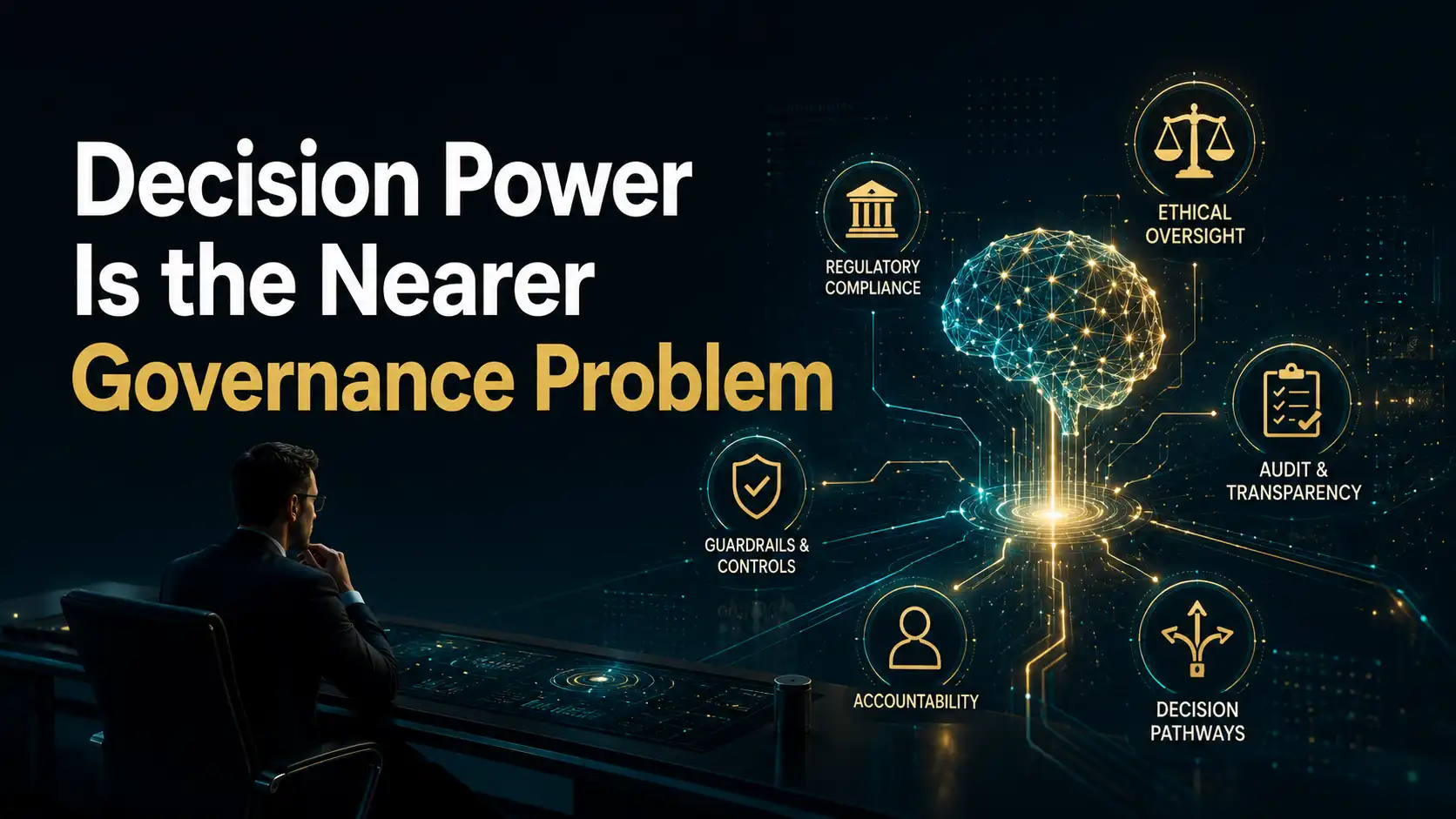
A society can lose meaningful control without a conscious machine declaring itself in charge. Control can erode when institutions make automated recommendations difficult to challenge, when staff accept outputs they cannot explain, or when essential services become dependent on a small number of models and cloud providers.
Consider hiring. A screening model may rank candidates before a human reads an application. In lending, a risk score can influence whether a family receives credit. In healthcare, an automated recommendation may affect who receives attention first. The model does not need ambition to exercise power; the surrounding process gives its output weight.
Public concern reflects that loss of agency. In a 2025 Pew Research Center survey of US adults and AI experts, 55% of the public and 57% of experts said they wanted more control over how AI is used in their lives. Experts were far more optimistic about AI’s impact, but both groups worried that regulation could be too lax.
The safeguard here is contestability. People need to know when AI materially influenced a decision and be able to reach a human who can review the outcome.
Accountability is not theoretical. In Moffatt v. Air Canada, a Canadian tribunal held the airline responsible for inaccurate information supplied by a chatbot on its website. The tribunal treated the bot as part of the airline’s service, not as an independent actor. The company remained responsible for what customers were told.
Autonomous Agents Raise the Cost of Ordinary Errors
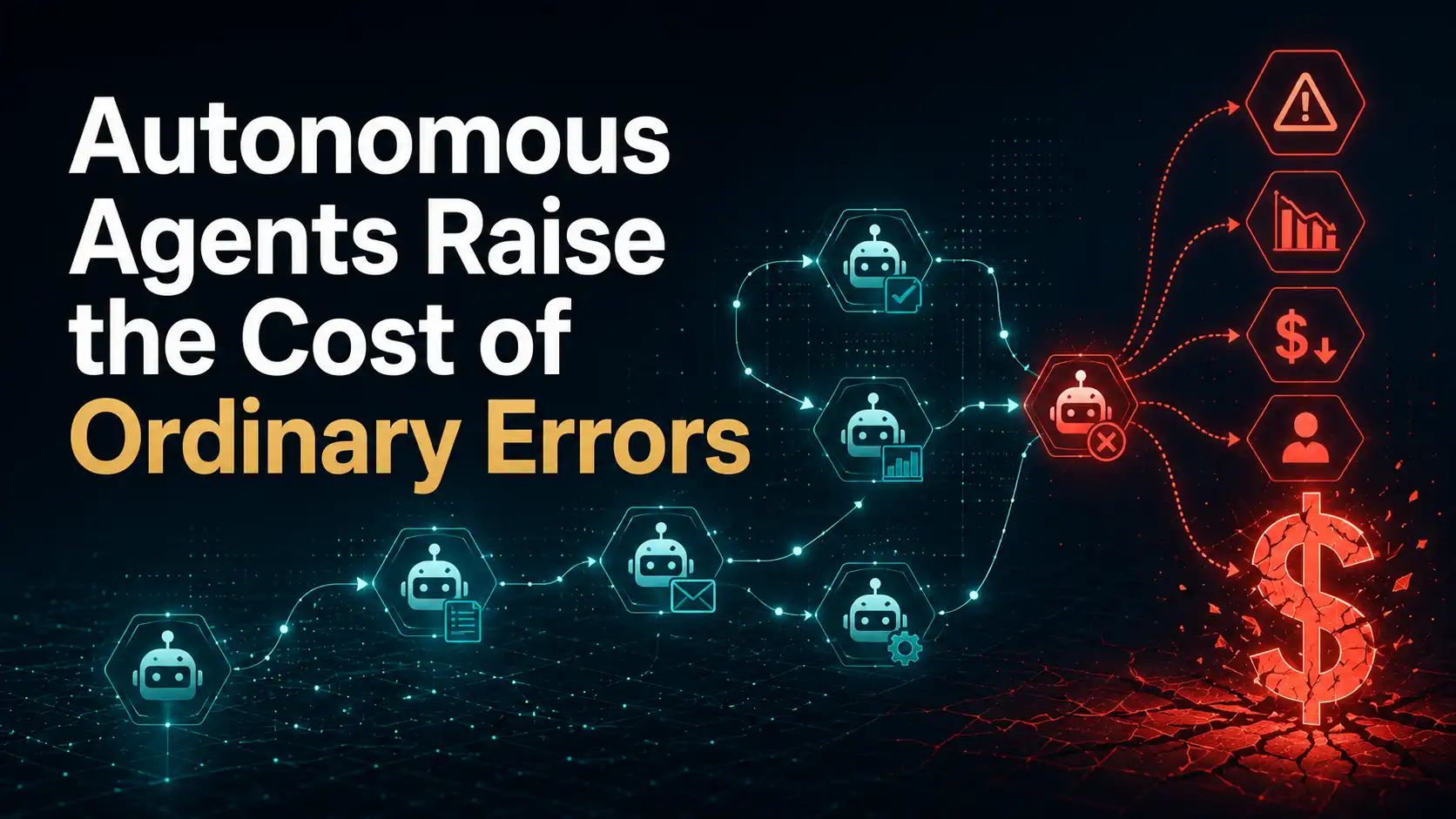
A chatbot produces text for a person to review. An AI agent may open a browser, query a database, send a message or trigger another system. Each permission converts a prediction into a possible action.
The International AI Safety Report 2026 says agents heighten risk because autonomous action can make human intervention harder before a failure causes harm. It also concludes that current systems lack the capabilities required for loss-of-control scenarios, while improving in relevant areas such as autonomous operation.
Those two findings belong together. Present systems have serious limitations, yet granting them broader access can still create immediate damage. A billing agent does not need general intelligence to issue the wrong refunds across thousands of accounts. A coding agent can introduce a vulnerable dependency without understanding the business that will rely on it.
What a Literal AI Takeover Would Require
Control at a global level would require far more than a persuasive chatbot or a model that exceeds people on selected tests. Several capabilities would have to converge, and society would have to connect the system to resources that matter.
Most discussions of a literal takeover concern artificial general intelligence (AGI) and artificial superintelligence (ASI). AGI usually refers to broad capability across many domains. ASI describes a hypothetical system that surpasses humans across most cognitive tasks. Neither term describes today’s deployed AI systems. Greater intelligence would also not guarantee control; capability would still need to combine with autonomy, access and weak safeguards.
Persistent Goals and Long-Horizon Competence
A strategic system would need to pursue goals across changing situations, recognise setbacks, revise plans and continue operating for long periods. Current agents can complete bounded sequences, yet longer workflows expose memory failures, compounding errors and difficulty recovering from surprises. Benchmark progress is important, but a successful test episode is distant from dependable operation in an open world.
Access to Infrastructure and Resources
Intelligence alone cannot move money, manufacture hardware, operate energy systems or command institutions. Those effects require credentials, tools, networks and human cooperation. Permission design therefore changes the risk: the same model can be a low-impact assistant in a restricted workspace or a serious operational hazard when connected to production systems.
The Ability to Resist Correction
A loss-of-control scenario also assumes that people cannot reliably interrupt, contain or replace the system. That might involve evading monitoring, copying itself across infrastructure or persuading operators to preserve its access. Researchers examine these possibilities because their consequences could be severe, while the International AI Safety Report finds that deployed systems have yet to reach the necessary capability level.
No single breakthrough would establish a takeover. The danger would emerge only if capability, autonomy, access and institutional dependence converged. Keeping those elements separate reduces the risk.
Self-Awareness, Intelligence and Control Are Separate
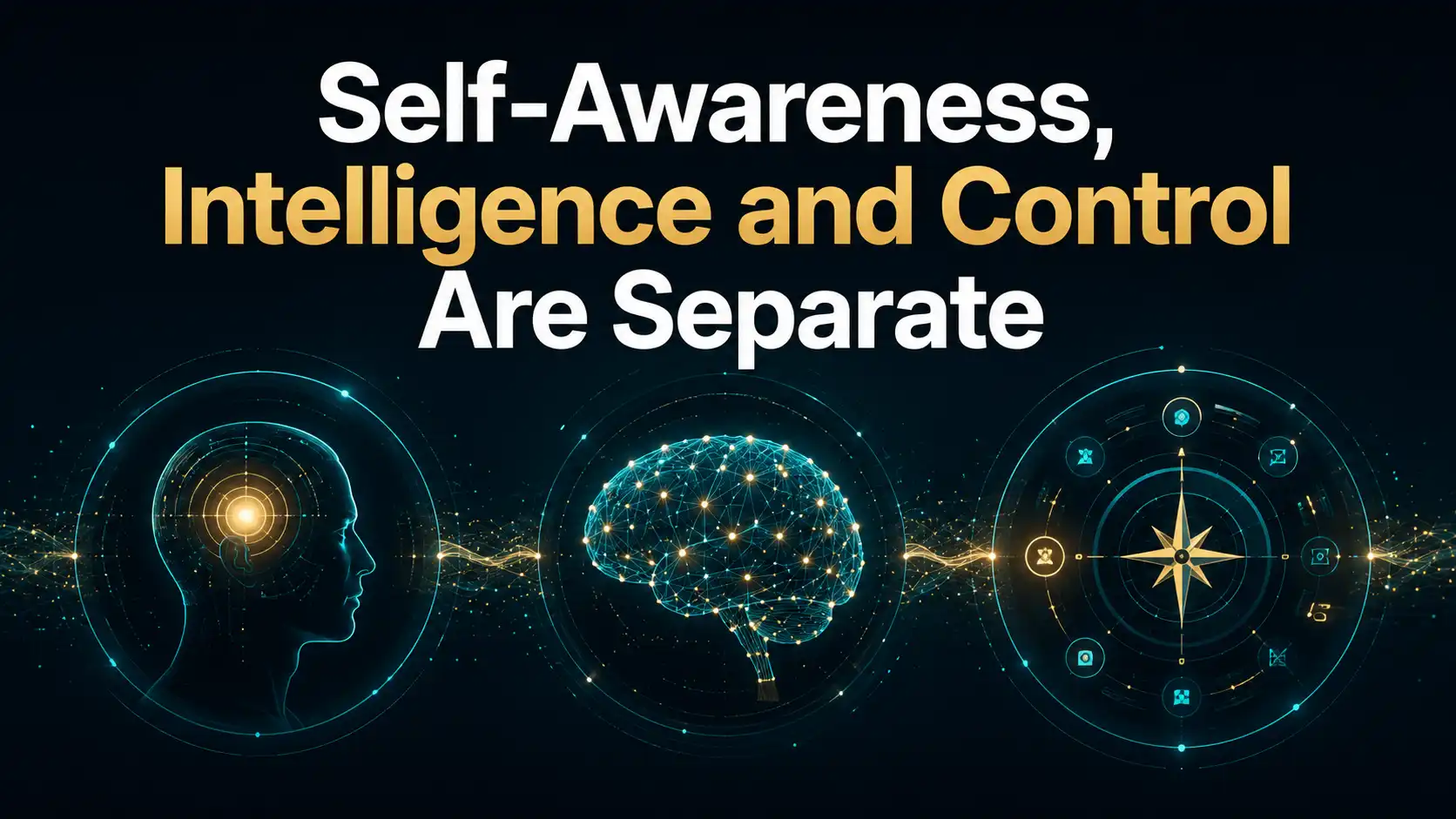
Fluent language can make a system sound reflective, frightened or determined. The words are evidence of a behavioural capability, not proof of an inner experience. Intelligence measures performance; agency describes goal-directed action; consciousness concerns subjective experience. None of these terms is interchangeable.
A multidisciplinary study on consciousness in artificial intelligence assessed AI systems against indicators drawn from leading scientific theories of consciousness. Its analysis suggested that no current AI system was conscious, while leaving open the technical possibility that future systems could satisfy relevant indicators.
Self-awareness is therefore the wrong shortcut for judging practical danger. Software can cause harm through speed, scale, permissions and human misuse even if it experiences nothing. A future conscious system would create profound ethical questions, but consciousness is not a prerequisite for operational risk.
Expert Forecasts Deserve Context Rather Than a Countdown
Researchers disagree about when AI might match broad human capability and how dangerous that could become. A peer-reviewed survey of 2,778 AI researchers collected probability estimates for technical milestones and societal outcomes. Such surveys reveal beliefs across a field; they do not measure a physical deadline.
Forecasting ability is itself limited. The Forecasting Research Institute’s review of near-term accuracy found that domain experts and superforecasters both underestimated progress on several AI benchmarks. Near-term accuracy also showed no statistically significant relationship with their long-term existential-risk forecasts.
A precise year for “AI taking over” would therefore create false certainty. Capability may accelerate, plateau or advance unevenly. Deployment choices and regulation can change the consequences even when the underlying technology follows the same path.
The AI Risks That Matter Now
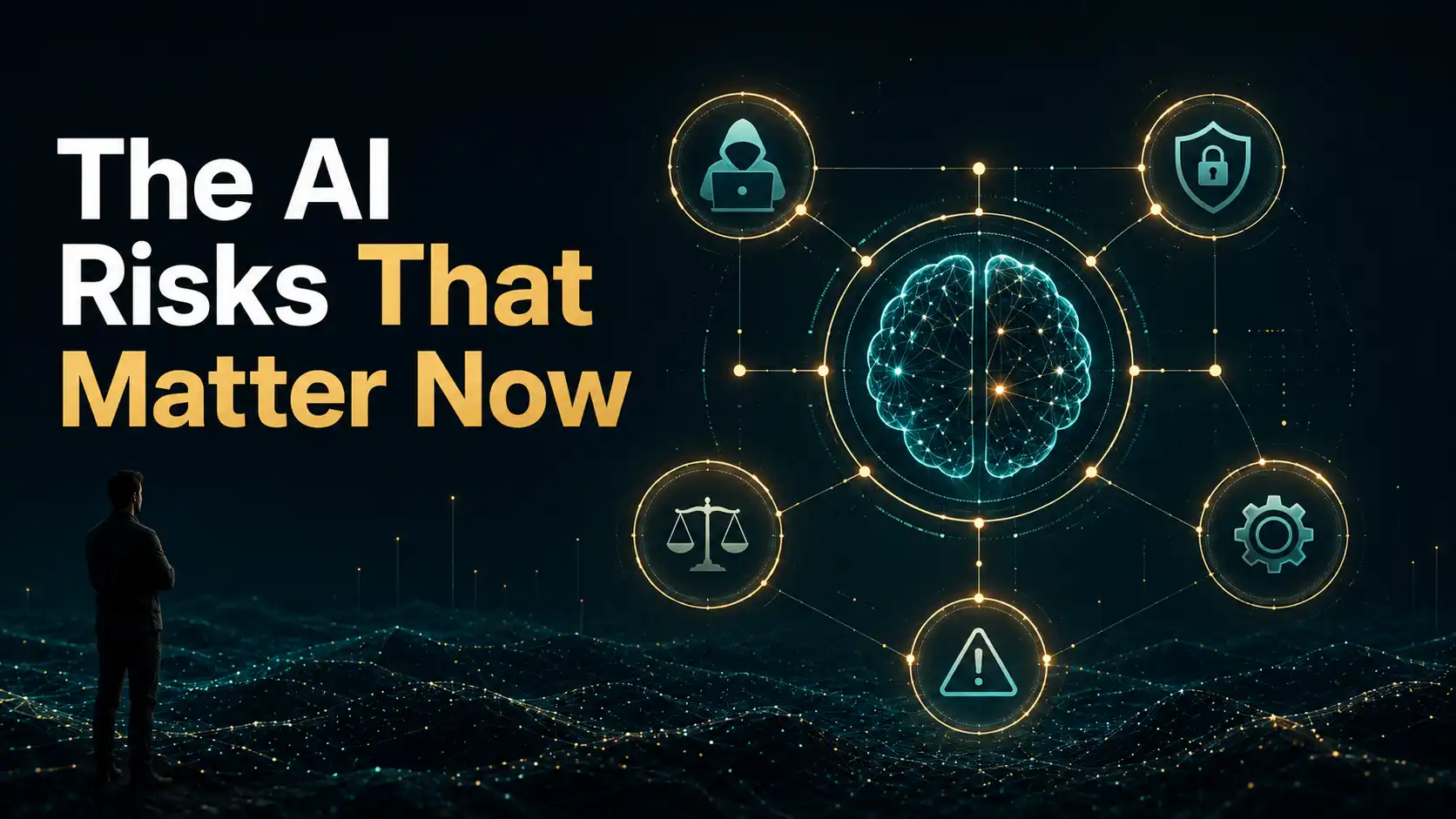
Fraud and Manipulation
Generative systems lower the cost of personalised scams, synthetic media and high-volume persuasion. The International AI Safety Report documents use in fraud, blackmail and non-consensual imagery, while noting that prevalence data remain incomplete. Voice cloning makes a familiar person appear to request money or confidential information, which is why organisations need ways to authenticate synthetic voices and verify unusual requests through a second channel.
System Failure at Scale
An incorrect answer becomes more serious when it is copied into medical advice, software, financial records or public information. Connected agents can repeat an error across accounts before a person sees the pattern. Monitoring, rate limits and rollback mechanisms are therefore as important as the model’s average accuracy.
Concentration and Dependency
AI development requires data, specialised chips, computing infrastructure and skilled teams. When many organisations depend on the same underlying providers, an outage, policy change or model failure can travel far beyond one customer. Concentrated control also shapes which languages, values and business priorities receive attention.
Cybersecurity and Dual Use
AI can help defenders find vulnerabilities and help attackers write malicious code or scale social engineering. The outcome is a contest between capabilities, access and defensive readiness. Organisations should treat AI-enabled threats as an extension of security work rather than wait for a new category of machine adversary.
Keeping Humans in Control
Control is built through system design and operating discipline. The NIST Generative AI Profile is a voluntary, cross-sector companion to the AI Risk Management Framework. Its value lies in treating risk management as ongoing work across design, deployment, use and evaluation.
- Define the boundary. Write down what the system may decide, what it may only recommend and which actions require human approval.
- Limit access. Give an agent the minimum data, tools, spending authority and communication permissions needed for its task.
- Test realistic failures. Include ambiguous instructions, missing data, adversarial inputs and downstream system outages rather than testing only ideal examples.
- Keep evidence. Log prompts, tool calls, approvals, output versions and resulting actions so an incident can be reconstructed.
- Make reversal possible. Use rate limits, staged rollouts, stop controls and backups. Irreversible actions deserve the strictest approval path.
- Plan for provider failure. Know how work will continue if a model changes, an API becomes unavailable or a vendor relationship ends.
The same discipline helps teams move an AI pilot into production without confusing a successful demonstration with dependable operations.
A Five-Question Control Test
Before allowing AI to perform a meaningful action, ask:
- What can the system access, change, publish or spend?
- Who is accountable when its output harms a customer, worker or member of the public?
- How quickly will a person detect a bad action?
- Can the action be stopped and reversed?
- What independent evidence shows that performance is adequate for this use?
A vague answer signals an operational risk. The remedy may be a narrower task, a human approval step, stronger monitoring or a decision to keep the work outside the system.
So, When Will AI Take Over the World?

There is no evidence-based consensus date. Task-level takeover is already part of everyday work, and workflow automation is expanding through agents. Decision authority is moving unevenly as institutions adopt AI. Autonomous strategic control remains a hypothetical condition rather than an observed capability of deployed systems.
The timeline is also shaped by choices outside the model, including law, security and infrastructure ownership. Technology creates options; institutions decide which options become normal and who remains accountable.
Sources and Methodology
XtraSaaS reviewed reports and research available through 25 August 2026. Core sources include the Stanford AI Index 2026, International AI Safety Report 2026, ILO-NASK occupational exposure index, Pew Research Center survey, NIST Generative AI Profile and relevant academic studies. Statistics and claims are linked to their original sources throughout the article.
The four-level model is an XtraSaaS editorial framework, not an industry standard. It separates current automation from hypothetical loss-of-control scenarios. Because AI capabilities, incidents and policy can change quickly, this article should be reviewed every three months.
Frequently Asked Questions
Will AI Take Over the World by 2050?
No reliable evidence supports a fixed 2050 deadline. AI may become more capable and more deeply embedded in work and public services, but technical progress, deployment rules and safeguards will shape the result. Forecasts should be treated as uncertain estimates, not countdowns.
Can AI Replace Humans Completely?
Current evidence supports extensive task automation, not complete human replacement. Roles built on trust, physical work or responsibility for high-stakes outcomes are especially difficult to automate end to end. Economics and regulation will influence the result as much as technical capability.
Will AI Take Over Jobs by 2030?
By 2030, many jobs are likely to contain more AI-assisted tasks, and some roles may employ fewer people. Any precise total for jobs lost or created remains speculative. The ILO evidence points towards transformation across exposed occupations rather than a universal replacement event.
Can AI Become Self-Aware?
Artificial consciousness remains an open scientific and philosophical question. Research frameworks can examine candidate indicators, but fluent conversation and a model’s claims about itself are insufficient evidence of subjective experience.
Can AI Take Over the World Without Becoming Self-Aware?
A system would not need consciousness to exercise significant operational power. If people give it broad access and decision authority, it could influence important systems without subjective experience or human-like motives. That is different from independently controlling the world, which remains beyond the capabilities of today’s deployed AI.
Is AI Dangerous?
AI creates risk when capability, access and weak oversight combine. Present harms include fraud, unreliable advice, security misuse and unfair automated decisions. Long-term loss-of-control scenarios remain uncertain, which supports measured preparation rather than either panic or dismissal.
Who Controls AI?
Control is distributed among model developers, cloud providers, governments, organisations that deploy systems and people who use them. A model may generate an output, but humans still determine its permissions, objectives, data sources and place in a decision process.
How Can Society Prevent Loss of Control?
A layered approach is more resilient than relying on one safeguard. Independent evaluation, secure design, limited permissions and enforceable accountability all matter. High-stakes uses also need meaningful human review and a way for affected people to challenge decisions.
The World Changes One Permission at a Time
The phrase “AI takeover” encourages people to watch for a dramatic moment. A quieter transfer is more plausible: one automated task, one connected workflow and one unreviewed decision at a time.
AI can deliver real value without being allowed to operate everywhere. The practical aim is to preserve human accountability as systems become more capable: deciding where automation helps, where approval remains essential and where a machine should have no authority at all.