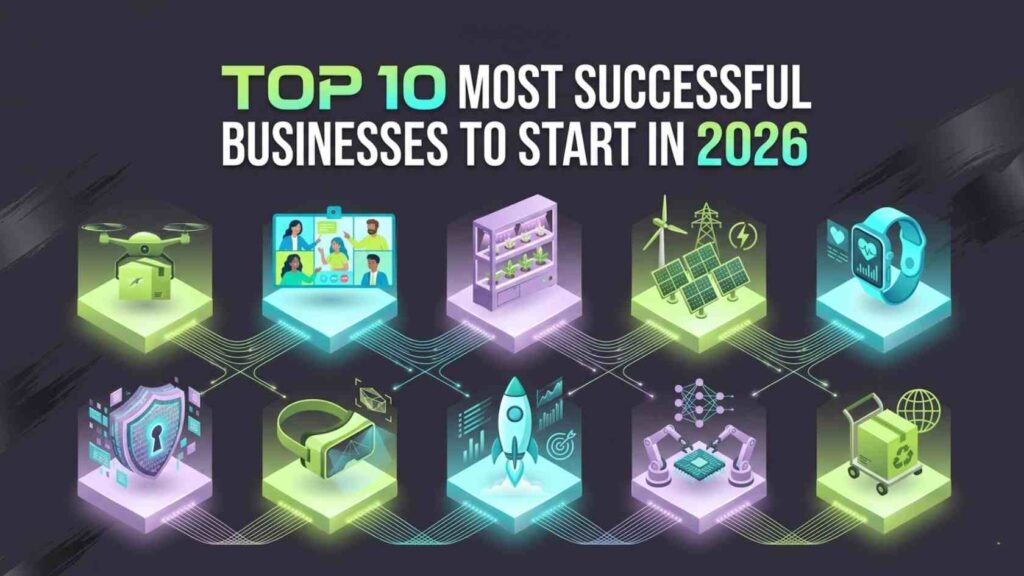
Want to start a business that thrives in today’s tough market? This list of the top 10 successful businesses can help you achieve financial freedom. These businesses combine low startup costs, high demand, and strong growth potential. If you’re exploring e-commerce, service businesses, or network marketing, these options have helped many earn six figures.
In this guide, we’ll explore each opportunity. You’ll find startup advice, practical tips, and why they are expected to succeed in 2026. It will help you in determining which business best suits your goals and skill set.
Why Choosing the Right Business Matters
Pick the right business by spotting real market needs. Focus on the top 10 most successful businesses to start. It’s not about following trends that won’t last. This focus on stability is key to your long-term success. The wrong choice can waste your time, money, and motivation. Many studies suggest that new businesses fail in their first year. This often happens due to poor market fit, as noted by the U.S. Small Business Administration. Using high-demand models such as digital services or franchises reduces risk.
High-growth sectors like online retail are expanding at around 15% annually. They provide clear ways to make profits and expand. Aligning with these trends helps your startup find a better work-life balance. It also supports building a sustainable business. Such models often generate passive income and create a lasting market impact.
Top 10 Most Successful Businesses to Start
Starting one of the top 10 successful businesses in 2026 means meeting steady demand. It also offers digital growth and tested models. Here’s our ranked list. We based it on insights from sources like Forbes, SBA reports, and industry research. We focused on options with low entry barriers (under $10K in startup cost) and an average ROI of over 50% in the first year.
Actionable Table
Here’s a quick comparison of the top 10 businesses based on cost, profitability, and future trends:
| Business Idea | Startup Cost | Time to Profit | Market Size | Future Trend |
|---|---|---|---|---|
| E-commerce | $2k–$50k | 6–12 mo | $1.2T USA | Subscription + AI (precedence research) |
| Digital Marketing | $500–$10k | 3–6 mo | $550B | Automation + AI (cognitive market research) |
| SaaS/App Dev | $5k–$100k | 12–24 mo | $250B | AI tools (precedence research) |
| Real Estate | $20k–$100k | 6–18 mo | $500B USA | Smart homes (Business Research Co.) |
| Health & Wellness | $2k–$50k | 3–12 mo | $7T | Virtual + AI (InsightAce Analytic) |
| Education | $500–$10k | 1–6 mo | $450B | Micro-learning (Technavio) |
| Green Business | $1k–$20k | 6–12 mo | $1.2T | Carbon-neutral (Research Nester) |
| Freelancing | $0–$2k | 1–3 mo | $1.3T | AI-assisted (precisionbusinessinsights.com) |
| Food & Beverage | $10k–$100k | 6–18 mo | $900B USA | Ghost kitchens (Market Research Future) |
| Creative/Arts | $500–$5k | 3–12 mo | $800B+ | NFTs & digital art (research nest) |
1. E-commerce & Online Retail

E-commerce offers global reach and low barriers to entry. Owners can use platforms like Shopify to launch stores in days. They can tap into a market that Statista reports reached $7.5 trillion in 2025. Analysts expect this market to grow by 15% each year through 2030.
Why it works: Dropshipping reduces inventory risk. Niche products like eco-friendly gadgets can yield profit margins between 30% and 50%, according to Shopify.
Startup costs: $500-$5,000 (domain, ads, tools)
Time to Profit: 6–12 months.
Pro tip: Use AI tools like Jasper for listings to boost conversions by 25%.
Actionable Steps:
- Identify a profitable niche (eco-friendly products, pet supplies, fitness gear)
- Confirm via pre-orders or ads
- Build a website and integrate a payment gateway
- Launch digital marketing campaigns
Success in e-commerce comes from strong branding and a great customer experience. It’s not just about the products. Quick shipping, solid product pages, and social proof—like reviews and user photos—increase conversions.
Extra Strategy: Focus on building a brand rather than dropshipping random products. Branded stores often achieve higher customer lifetime value (LTV) and repeat purchases.
2. Digital Marketing & Online Services

As businesses shift online, digital marketing services have become essential. Companies are investing heavily in online visibility. They use SEO, paid ads, influencer marketing, and content creation. These strategies help brands connect with more people. Analysts expect demand to rise 22% by 2026 (HubSpot). This market growth offers significant opportunities for freelancers. They can earn $50 to $200 an hour.
Why it works: Services like SEO, social media management, and PPC thrive on retainers. These usually average $2K per client each month (Forbes).
Startup costs: $200-$2,000 (software like Ahrefs and a website)
Time to Profit: 3–6 months
Pro tip: Specialize in short-form video ads to boost client retention by up to 40%.
Actionable Steps:
- Begin by freelancing or starting a small agency
- Build a portfolio of small client projects or case studies
- Scale with retainer contracts
Extra strategy: Focus on one area to stand out. Be an expert in TikTok ads, lead generation, or email marketing. Specialists often charge higher rates than generalists.
3. Software as a Service (SaaS) & App Development

SaaS businesses are powerful because they generate predictable, recurring revenue. With the rise of no-code and low-code tools, even non-developers can now build and launch apps. Simple SaaS tools can replace expensive enterprise software with more affordable, scalable solutions. This software market grew 18% to $200B in 2025 (Web Work), with no-code platforms slashing dev time.
Why it works: Subscription models (like $10-99/month) generate steady income. Plus, successful ones keep churn below 5%.
Startup costs: $1,000–$10,000 (Bubble.io, hosting)
Time to Profit: 12–24 months
Pro tip: Focus on AI integrations for 3x user growth.
Actionable Steps:
- Identify pain points (remote work tools, AI services)
- Build MVP and test with early users
- Launch subscription model
Extra strategy: Start with a “micro-SaaS” targeting a very specific problem. Smaller tools can grow faster than large platforms. They need less development time and meet urgent, niche needs. Bigger companies often overlook these needs.
4. Real Estate & Property Management

Real estate remains a strong wealth-building business, especially in growing markets. It is a proven model for small business success. Income can come from leasing, property appreciation, and management services.
Why it works: Passive income from 8–12% yields; management fees provide more than 10% in revenue.
Startup costs: $5,000–$50,000 (licensing, marketing)
Time to Profit: 6–18 months
Pro tip: Use VR tours to list 2x faster.
Actionable Steps:
- Start with rental properties or short-term rentals
- Consider delegating property management from the beginning to save time and scale faster
- Scale by adding more properties
Extra strategy: Start with low-capital models, like rental arbitrage or property management. Then, you can move into full ownership.
5. Health & Wellness

Health and wellness businesses are growing rapidly due to increased awareness of mental and physical well-being. More people are aware of their mental and physical health. Online coaching, fitness programs, and wellness products are in high demand. Tele-fitness apps are growing rapidly and are expected to see significant market expansion by 2026. (swisspreneur). Personalized coaching shines.
Why it works: High margins (70%+ on digital programs) and repeat clients via apps.
Startup Costs: $1,000-$5,000 (for certifications, Zoom setup)
Time to Profit: 3–12 months
Pro tip: Bundle with wearables for a 35% upsell conversion rate.
Actionable Steps:
- Offer online coaching, apps, or local wellness services
- Partner with gyms or wellness centers
- Expand via subscriptions or memberships
Post regularly on Instagram and YouTube. This helps build your authority. Audience trust directly converts into paying clients. Another rapidly growing sector is education.
6. Education & Online Learning

Another fast-growing sector is education, which is booming. People are choosing to invest in new skills instead of traditional degrees. Similarly, the health and wellness industry is also growing rapidly. Courses, coaching programs, and memberships yield significant profits. Online courses are one of the best businesses to start in the digital education space. Analysts expect EdTech to reach $400B by 2026. Platforms like Teachable help experts easily earn money from their knowledge.
Why it works: One-time creation, infinite sales (80% margins); niches like coding for kids boom.
Startup costs: $500-$3,000 (course tools, ads)
Time to Profit: 1–6 months, depending on audience growth.
Pro tip: Adding community forums can improve course completion rates by up to 50%.
Actionable Steps:
- Identify high-demand topics (coding, business, language)
- Develop course content & test with a small audience
- Use social media ads and partner with influencers to launch your course
Extra strategy: Provide certificates, live sessions, or mentorship. This boosts perceived value and supports premium pricing.
7. Green & Sustainable Businesses

Sustainability is no longer a trend—it’s becoming a standard. Consumers are making deliberate choices in favor of eco-friendly brands, even at higher prices. This inspires top businesses to launch everything from upcycled fashion to solar installs. The market is growing by 25%, reaching $12 trillion (Commerce Engine).
Why it works: Grants + 20-40% markup; B2B contracts scale fast
Startup costs: $2,000–$10,000
Time to Profit: 6–12 months
Pro tip: Certify with ISO for a 30% sales lift.
Actionable Steps:
- Select and source eco-friendly products like home goods, clothing, and energy solutions
- Market via social media and influencer partnerships
- Offer subscription boxes or B2B services
Extra strategy: Use storytelling in marketing. Show how your product makes a difference, such as reducing plastic waste. This builds an emotional connection and loyalty.
8. Freelancing & Consulting Services

Freelancing is one of the fastest ways to earn money with minimal investment. This path allows people to monetize their skills globally, especially in areas like strategy and consulting. Upwork gigs average $40 per hour, while top earners make $300,000 a year (Outsource Accelerator).
Why it works: Zero inventory, global clients; retainers build stability
Startup costs: $100-$1,000
Time to Profit: 1–3 months
Pro tip: Use testimonials for 4x client acquisition.
Actionable Steps:
- Offer services in marketing, writing, IT, and finance
- Build portfolio & leverage platforms (Upwork, Fiverr)
- Scale by starting an agency or securing retainer contracts
Extra strategy: Build a personal brand on LinkedIn or Twitter. Many high-paying clients are acquired through inbound interest rather than freelance marketplaces.
9. Food & Beverage Ventures

The food industry remains evergreen because demand is constant. With the rise of delivery apps, businesses no longer need expensive dine-in spaces. Food trucks and cloud kitchens are strong and profitable business models. Ghost kitchens are set to grow by 30% by 2026, according to kioskindustry. Low-cost models let entrepreneurs test niche ideas, like fusion flavors, in local markets. This allows them to test ideas with very low risk.
Why it works: 60% margins on high-demand items; apps like Foodpanda amplify reach.
Startup costs: $10,000-$50,000 (equipment, permits)
Path to profits: Test pop-ups or scale a spice brand into a franchise.
Pro tip: Opt for a cloud kitchen model to significantly reduce operational costs.
Actionable Steps:
- Start with small food trucks or cloud kitchens
- Focus on delivery or niche audiences
- Scale with franchising or company-owned expansion
Extra strategy: Start with a limited menu to reduce costs and improve quality control. Scale the product once you validate demand.
10. Creative & Arts Businesses

The creator economy gives artists, designers, and content creators new ways to make money. Platforms enable monetization of digital goods, retail, and subscriptions. In the $100 billion creator economy, innovative ideas are thriving. NFT art and personalized goods are just two examples (Goldman Sachs, 2026). Print-on-demand democratizes it. Why it works: Patreon fosters fan devotion, viral potential, and 50% margins.
Startup costs: $300–$2,000 (design tools, Printful)
Pro tip: Use Web3 for exclusive drops. This can boost your revenue through secondary sales and create scarcity.
Actionable Steps:
- Sell on Etsy, Amazon Handmade, or NFT marketplaces
- Market via social media and online communities
- Scale via brand collaborations
Extra strategy: Start with one platform, like Instagram or TikTok. Build your audience there. Then, expand into monetization options, such as merch or memberships.
How to Choose the Right Business
Choose a business that aligns with your strengths and current market demand. Evaluate your skills, passion, and resources. Freelancing works well for SEO experts like you. Digital education ventures also enjoy your content creation knowledge.
Self-Assessment Steps
- List your skills: Note what you excel at, such as writing or digital marketing. Then, compare these to the top 10 fields. Digital services and education offer great, low-cost options.
- Confirm demand: Look at Google Trends for niches like health & wellness. It’s up 25% in US searches. Also, survey 50 potential customers through social media.
- Budget check: Focus on startups under $5K, like e-commerce or consulting. Make sure you have 3 to 6 months of runway.
Future Trends in Business (2026 & Beyond)
As we head into 2026, AI and sustainability drive profitable business ideas to launch. Expect hyper-personalized e-commerce through VR shopping. This market could reach $8 trillion, according to Gartner. Also, SaaS tools may automate 40% of jobs. Green tech and health AI will create profitable business opportunities in the future. Also, blockchain will make payments easier for freelancers and small businesses.
Quantum computing boosts app development, while metaverse education platforms explode by 50%. The best businesses to start? Those blending human creativity with tech—think AR wellness coaching. Adapt now for exponential growth.
Common Mistakes
In the best industries, new entrepreneurs often fail. They keep making the same mistakes again and again. Here’s a summary of the top 7 launch challenges from 2026 and their solutions.
Skipping market research can be risky. Thinking “everyone’s your customer” often leads to failure. In fact, most failures occur due to a lack of demand validation.
Fix: Survey 100 prospects and analyze competitors first.
Poor cash flow management can be deadly. Overspending on fancy offices or ads, without tracking cash flow, is one of the main reasons startups fail.
Fix: Use QuickBooks; aim for a 6-month runway.
Mixing up revenue and profit can be risky. Cheering for sales without considering costs, margins, or low prices can hurt your funds.
Fix: Ensure your pricing covers costs and maintains healthy profit margins.
Lack of a company plan: A 29% failure rate results from launching without goals or study.
Fix: Create a one-page plan that addresses milestones, the market, and funding.
Doing everything solo: Burnout from refusing delegation stalls growth
Fix: Hire freelancers early via Upwork for non-core tasks.
Ignoring the legal setup can cause issues. Skipping contracts, IP protection, or proper structures can cause lawsuits and tax issues.
Fix: Create an LLC on the first day and use LegalZoom templates.
Premature scaling is the term for scaling too quickly without product-market fit, which is costly.
Fix: Before recruiting, attain a steady $10K MRR.
Avoid these mistakes if you want to succeed in e-commerce, freelancing, or the food business.
Call to Action
Are you prepared to build one of the top ten most successful businesses in 2026? Choose a business idea today. Test it within 7 days. Take your first step toward a profitable future!
Conclusion
In summary, if you’re planning to start a business in 2026, consider e-commerce, digital marketing, food ventures, or freelancing. These top 10 most successful businesses offer clear paths to financial freedom, with strong growth potential and easy entry. Avoid common mistakes, such as poor planning, and embrace trends like environmentalism and artificial intelligence. Draw inspiration from real success stories.
In this manner, you’re prepared to launch a profitable business. Your content and SEO abilities are a good fit for online shopping and digital marketing. Choose one, validate it, and launch it right now.
FAQS
What skills do individuals need to succeed in modern businesses?
Most modern businesses require a combination of technical and soft talents for success. Key skills include communication, marketing, problem-solving, time management, and basic finance knowledge. In 2026, digital abilities will be essential. This covers data analysis, content production, and social media marketing.
As a novice, how can I increase my chances of success?
Start small. Validate your idea. Focus on real problems and find solutions. Stay consistent. Continue learning, adapt to trends, and pay attention to what customers have to say. You may raise your odds of success sustainably by following these measures.
How much does it cost to launch one of these companies?
Most companies require between $500 and $50,000. Digital choices that cost less than $5,000 include e-commerce and freelancing. For bootstrapping, these are excellent.
Which business is best for beginners?
Freelancing, consulting, and digital marketing require very little startup capital. Develop SEO skills and grow from anywhere.
Can I succeed without prior experience?
Yes—use no-code tools, online courses, and platforms like Shopify or Upwork to learn on the go.