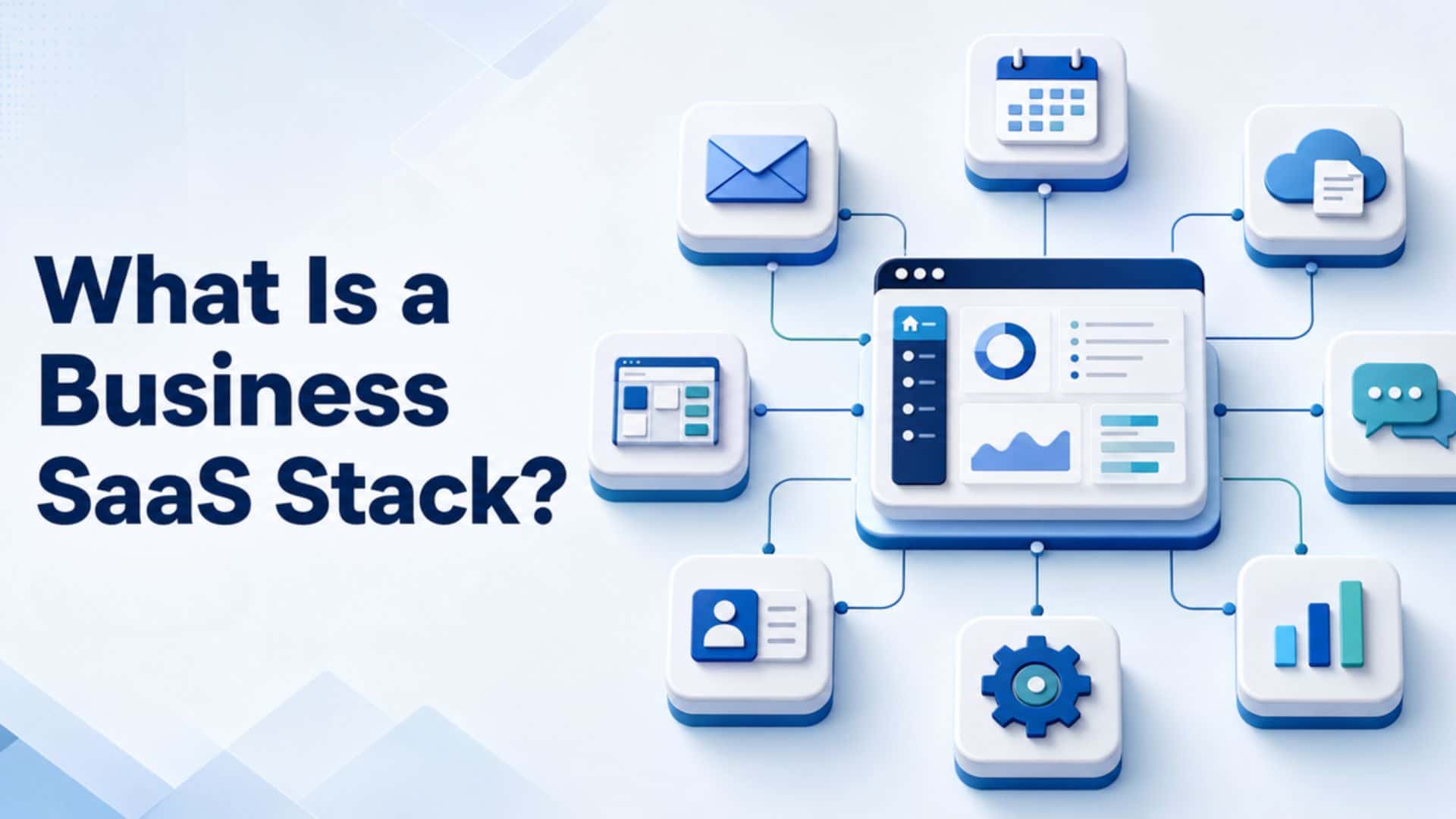
Some SaaS products are designed for almost any business. Others make sense only to people working in a particular industry. That is the basic difference between horizontal and vertical SaaS.
Horizontal SaaS solves a common business problem across many sectors, while vertical SaaS is built around the workflows, terminology and constraints of one industry. Neither model is automatically better. The right choice depends on the problem being solved and how much industry-specific depth the customer needs.
One point is worth clearing up first: horizontal and vertical describe a product’s market scope, not its technical architecture. Both can be cloud applications, sold by subscription and used through a browser. The US government’s Cloud Information Center, for example, defines SaaS as a method for delivering software applications over the internet, usually on demand and by subscription.
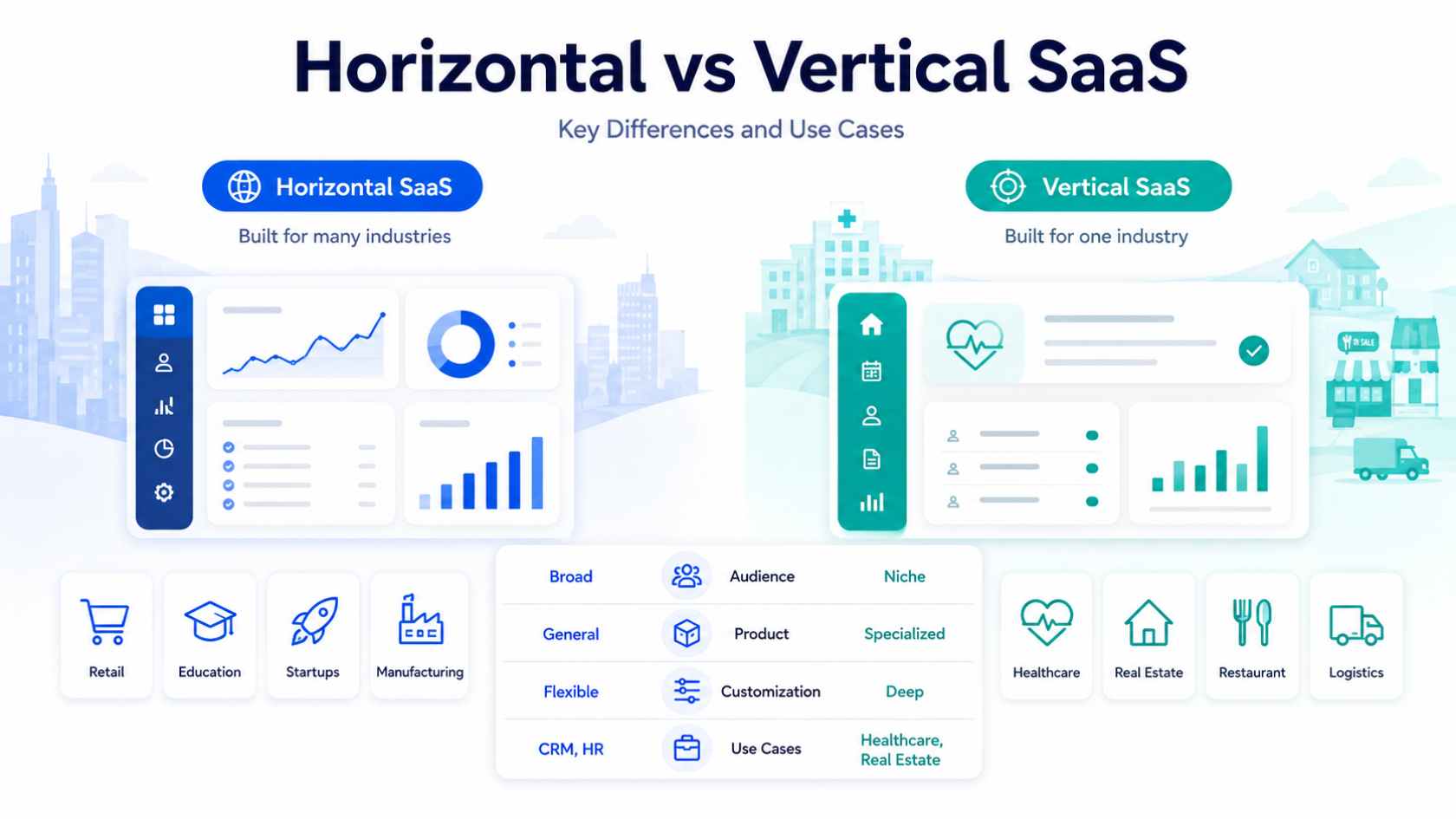
Horizontal vs Vertical SaaS at a Glance
| Area | Horizontal SaaS | Vertical SaaS |
| Target market | Businesses across many industries | One industry or a closely related group |
| Problem solved | A widely shared function | An industry-specific workflow |
| Typical examples | Team communication, CRM, accounting, project management | Construction management, restaurant operations, life-sciences software |
| Product language | General business terminology | Industry vocabulary and processes |
| Market size | Broad potential customer base | Smaller, more defined market |
| Customisation needs | May need integrations or configuration | More relevant features available out of the box |
| Go-to-market | Often organised by company size or department | Often built around industry expertise and relationships |
| Main risk | Crowded category and weak differentiation | Limited market size and dependence on one sector |
What Is Horizontal SaaS?
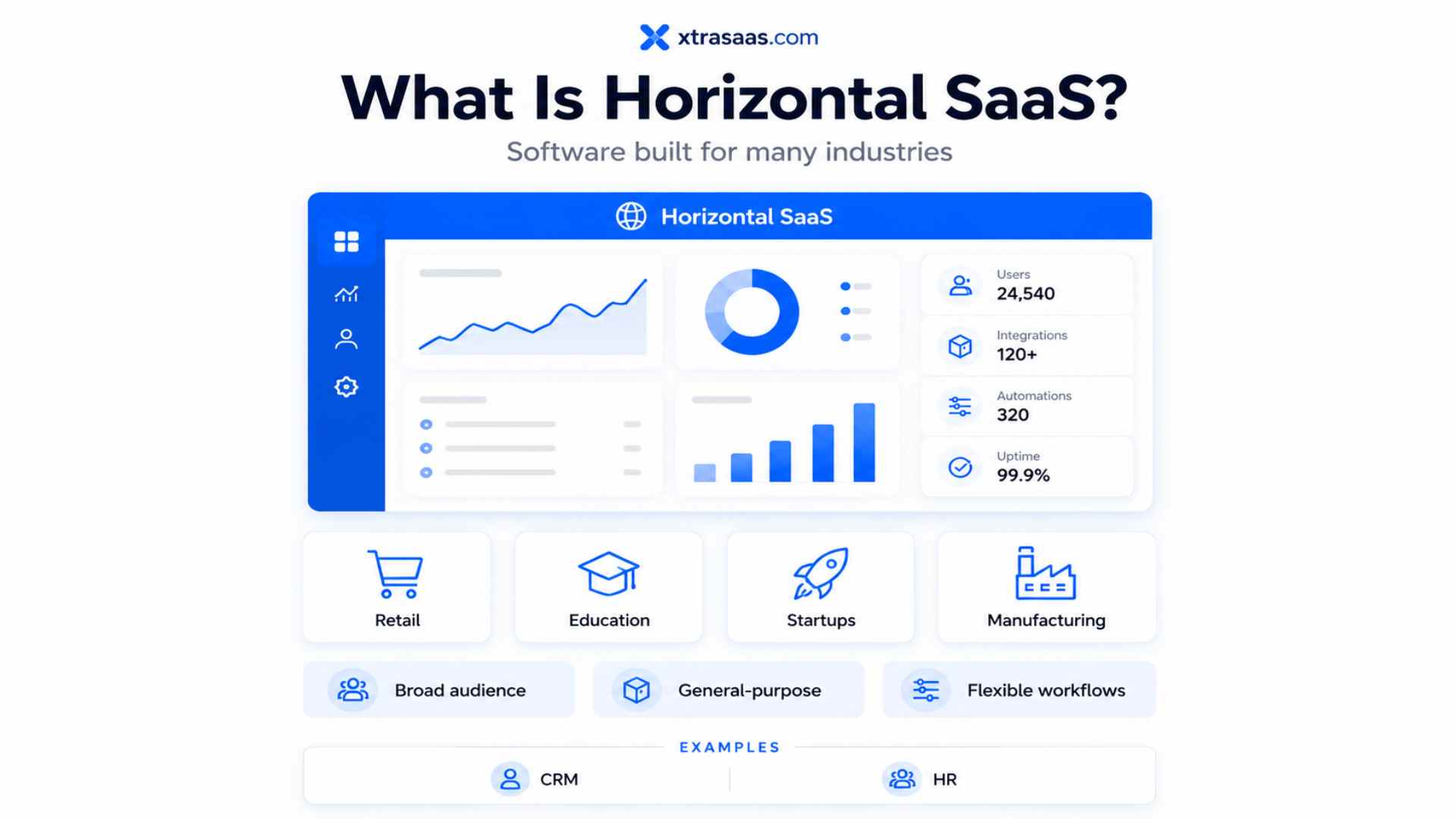
Horizontal SaaS serves the same function for customers in different industries. A manufacturer, a marketing agency and a university may all need messaging, document sharing, payroll or customer relationship management, even though their day-to-day work is very different.
Slack is a clear example. Its channels, workflows and integrations can support engineering, sales, HR and other teams across sectors. Slack currently lists more than 2,600 business-tool integrations, which reflects the central challenge for horizontal products: they must connect with many different working environments.
CRM platforms such as HubSpot are another example. Contact records, sales pipelines and meeting scheduling are not tied to a single industry. The same underlying product can be configured for an agency, software company or professional-services firm.
The broad market gives horizontal vendors room to grow, but it also attracts competitors. A generic tool can become difficult to distinguish unless it is easier to use, integrates better or handles a common job noticeably well.
Where Horizontal SaaS Works Well
- The problem exists in many types of organisations.
- Customers use broadly similar workflows.
- The product benefits from a large integration ecosystem.
- Industry rules do not fundamentally change the job being done.
- A company wants one standard tool across departments or locations.
For buyers, the appeal is familiarity and flexibility. The trade-off appears when a team has to reshape a general-purpose product around a specialised process. That can mean extra integrations, custom fields, workarounds or consulting.
What Is Vertical SaaS?
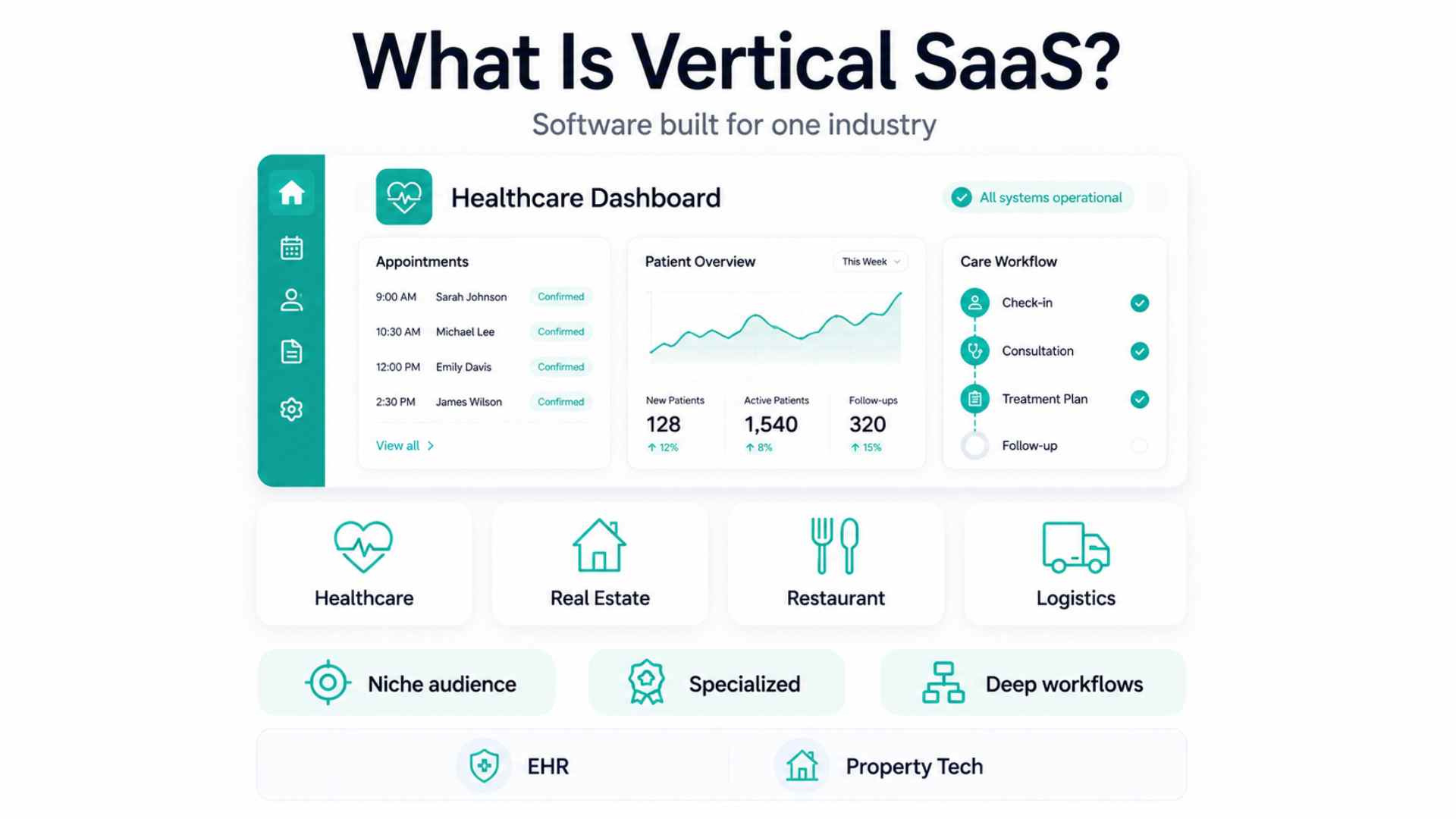
Vertical SaaS is designed for a particular industry. It does not simply give a general tool an industry-themed landing page; its features reflect how people in that sector actually work.
Veeva’s industry cloud for life sciences covers areas such as clinical, regulatory, quality, safety and commercial operations. Procore’s connected construction management platform serves owners, developers, general contractors and specialty contractors. Toast takes the same focused approach with a restaurant-focused product suite covering point of sale, kitchen-ready hardware, payroll, scheduling and supplier accounting.
These products illustrate the value of vertical depth. A restaurant does not just need a generic payment screen; it may need menu management, kitchen routing, tips and multi-location reporting. A contractor must coordinate drawings, budgets, site records and several project stakeholders. When those needs shape the product from the start, less adaptation is required.
The narrower focus has costs. A vertical vendor has a smaller addressable market and is more exposed to slowdowns or rule changes in that sector. Product teams also need credible domain knowledge. Missing an industry detail can matter more than lacking a fashionable feature.
Where Vertical SaaS Works Well
- The industry has specialised terminology or multi-step workflows.
- Generic tools require extensive customisation.
- Customers need several connected functions in one system.
- Domain expertise affects product design, onboarding and support.
- Industry-specific integrations create a meaningful advantage.
Which Model Makes More Sense?
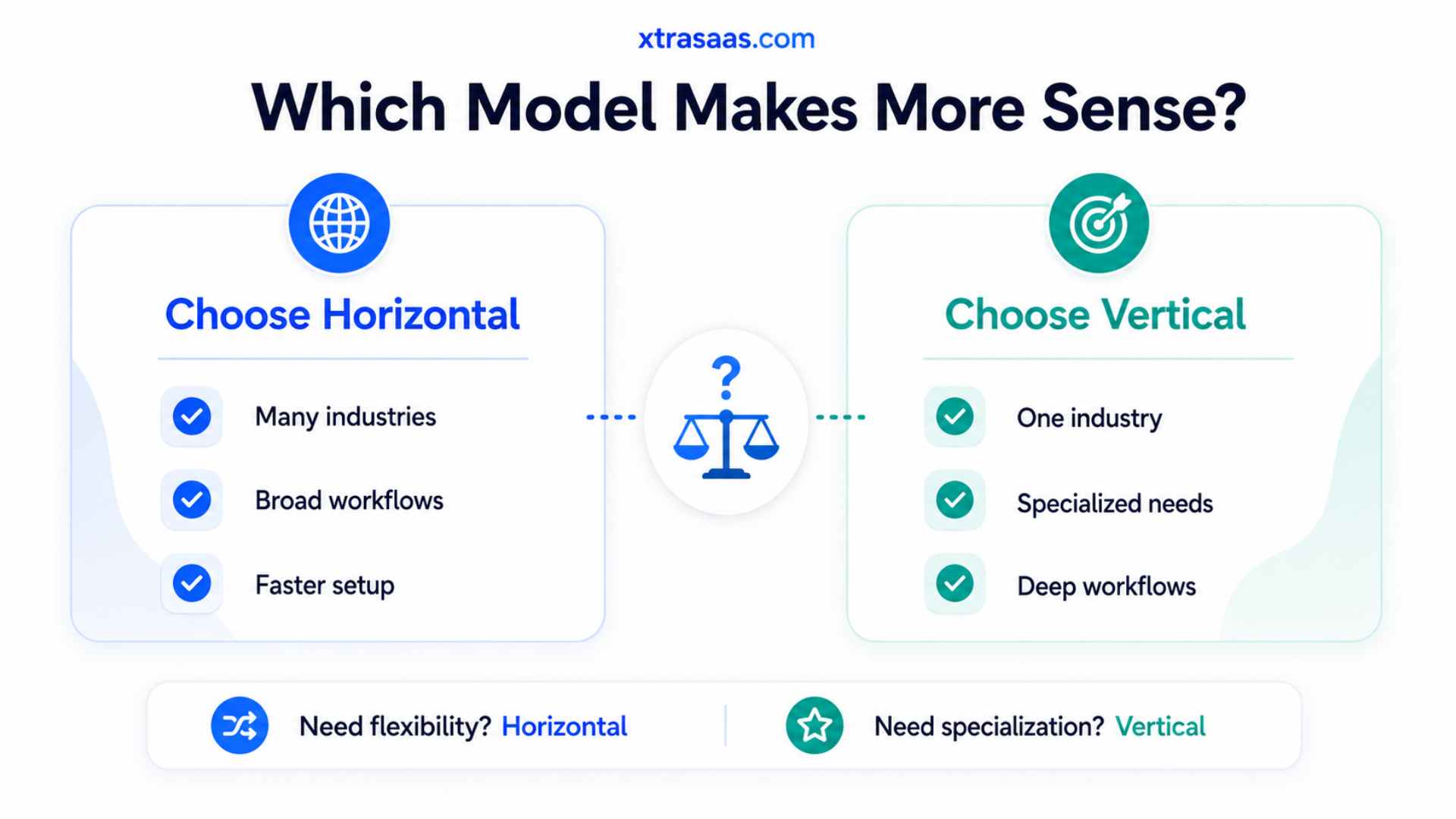
For a buyer, start with the workflow rather than the category label. If the job is standard – team chat or document collaboration, for example – a horizontal product may provide better compatibility and a larger user community. If the job sits at the centre of industry operations, a vertical platform may reduce workarounds and separate systems.
A five-question check is usually enough:
- How unusual is the workflow? Write down the steps that a general tool cannot handle cleanly.
- What must the software connect to? Check the actual integrations, not just the number advertised.
- How much configuration is realistic? A flexible platform loses its advantage if it requires months of setup.
- Does the vendor understand the users? Look at product terminology, implementation support and customer examples from the same field.
- Will the tool remove or add complexity? Buying several overlapping applications can contribute to SaaS sprawl, even when each purchase seems reasonable on its own.
For founders, the decision is strategic. Horizontal SaaS offers a wider pool of potential customers, but usually demands sharper positioning in a competitive market. Vertical SaaS provides a clearer customer profile and more specific product requirements, yet growth may depend on expanding into adjacent workflows, customer segments or regions.
Can a SaaS Product Be Both?
Yes. The categories are useful, but they are not permanent boxes. A horizontal platform may create industry editions with tailored templates, integrations and sales teams. A vertical vendor may expand from one core workflow into payments, analytics, staffing or supplier management. The product can become broader without abandoning the industry knowledge that made it useful.
The test is not how the company describes itself. Ask who can use the core product without substantial modification. If the answer spans unrelated industries, it leans horizontal. If the value depends on one sector’s operating model, it remains vertical.
Final Takeaway
Horizontal SaaS goes wide: it addresses a common function for many kinds of organisations. Vertical SaaS goes deep: it handles the connected workflows of a defined industry.
Choose horizontal software when standardisation, compatibility and broad use matter most. Choose vertical software when industry fit can replace workarounds and disconnected tools. In practice, the better product is the one that matches the real workflow with the least unnecessary complexity.
Frequently Asked Questions
What Is an Example of Horizontal SaaS?
Slack is a horizontal SaaS example because teams in many industries use it for communication, workflows and app integrations. CRM, cloud accounting and general project-management products can also be horizontal.
What Is an Example of Vertical SaaS?
Procore is a vertical SaaS example because its platform is built around construction projects and the people who manage them. Veeva in life sciences and Toast in restaurants are other examples.
Is Vertical SaaS Better Than Horizontal SaaS?
Not in every case. Vertical SaaS can offer a closer industry fit, while horizontal SaaS often provides broader integrations and easier use across departments. The best option depends on the workflow, implementation effort and systems already in place.
Why Do Founders Build Vertical SaaS Products?
A defined industry gives founders a clearer user group and more specific problems to solve. Strong domain knowledge can also make the product harder to copy. The trade-off is a smaller market and greater dependence on conditions within that sector.